- Specialities
- Center of Excellence
- Specialitites
- ANAESTHESIA & INTENSIVIST
- BREAST SURGERY
- CRITICAL CARE
- DERMATOLOGY
- DIALYSIS
- DENTISTRY & MAXILLOFACIAL SURGERY
- ENT
- INTERNAL MEDICINE
- INTERVENTIONAL RADIOLOGY
- LAPAROSCOPIC & GENERAL SURGERY
- OBSTETRICS & GYNAECOLOGY & COSMETOLOGY
- OPHTHALMOLOGY (EYE CARE)
- PEDIATRIC CARE & NEONATOLOGY
- PHYSIOTHERAPY & REHABILITATION
- Services
- AMBULANCE SERVICES (24/7)
- BONE MARROW TRANSPLANT
- BLOOD CENTER (OPEN 24/7)
- EMERGENCY SERVICES (AVAILABLE 24/7)
- LAB AND PATHOLOGY (OPEN 24/7)
- NEONATAL INTENSIVE CARE UNIT (NICU) & PEDIATRIC INTENSIVE CARE UNIT (PICU)
- NUTRITION & DIETETICS
- PHYSIOTHERAPY & REHABILITATION SERVICES
- PREVENTIVE HEALTH CHECKUPS
- PHARMACY (OPEN 24/7)
- PET/CT SCAN
- RADIOLOGY & IMAGING SERVICES
- Blogs
- Health Library
- Our Empanelment
- About Sarvesh

- Specialities
- Center of Excellence
- Specialitites
- ANAESTHESIA & INTENSIVIST
- BREAST SURGERY
- CRITICAL CARE
- DERMATOLOGY
- DIALYSIS
- DENTISTRY & MAXILLOFACIAL SURGERY
- ENT
- INTERNAL MEDICINE
- INTERVENTIONAL RADIOLOGY
- LAPAROSCOPIC & GENERAL SURGERY
- OBSTETRICS & GYNAECOLOGY & COSMETOLOGY
- OPHTHALMOLOGY (EYE CARE)
- PEDIATRIC CARE & NEONATOLOGY
- PHYSIOTHERAPY & REHABILITATION
- Services
- AMBULANCE SERVICES (24/7)
- BONE MARROW TRANSPLANT
- BLOOD CENTER (OPEN 24/7)
- EMERGENCY SERVICES (AVAILABLE 24/7)
- LAB AND PATHOLOGY (OPEN 24/7)
- NEONATAL INTENSIVE CARE UNIT (NICU) & PEDIATRIC INTENSIVE CARE UNIT (PICU)
- NUTRITION & DIETETICS
- PHYSIOTHERAPY & REHABILITATION SERVICES
- PREVENTIVE HEALTH CHECKUPS
- PHARMACY (OPEN 24/7)
- PET/CT SCAN
- RADIOLOGY & IMAGING SERVICES
- Blogs
- Health Library
- Our Empanelment
- About Sarvesh
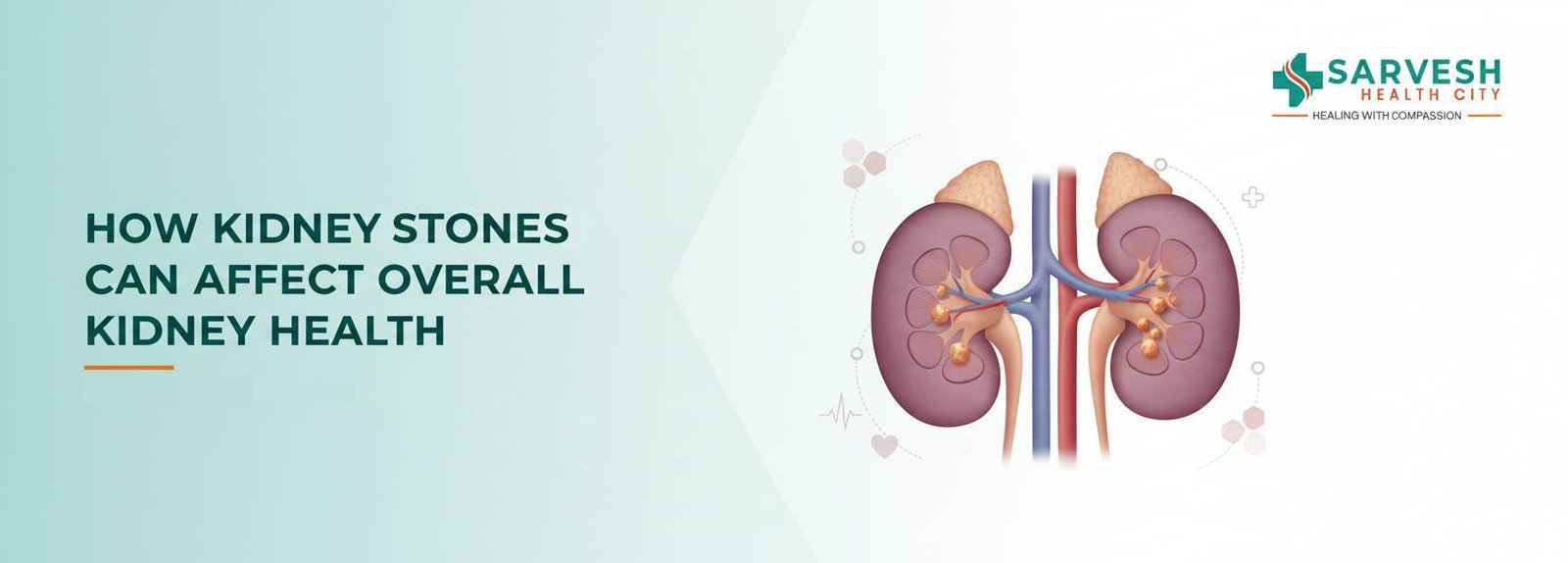
Kidney stones are the fastest-growing human health concern, while many people see them as just a short-lived pain, their influence on kidney health can be substantial in the long run. These stones can block the urine passage, cause infections, and, if not dealt with in time, lead to irreversible kidney damage.
This article will help you understand the impact of kidney stones on overall kidney function and the reasons to intervene at the earliest stage. Sarvesh Health City, the best urology hospital in Hisar can help you deal with kidney diseases effectively.
What Are Kidney Stones?
Kidney stones are hard masses that occur when minerals and salts in the urine combine and crystallize. They form when urine becomes too concentrated, which in turn causes substances such as calcium oxalate and uric acid to chemically bond and form crystals. Eventually, these tiny crystals grow quite large and may either remain in the kidney or make their way into the urinary tract.
Usually, the onset of kidney stones is abrupt and the symptoms can be quite painful and hard to ignore. Generally, the pain is the first and the most severe symptom. Initially, it is located in the back or side, and if the stone is moving, the pain can be felt in the lower abdomen or groin. This pain may come and go and can get so intense that it is necessary to seek medical help immediately.
Some of the immediate effects include:
- Sharp or changing pain: The movement of the stone along with the urinary tract is the reason for the fluctuating and very painful discomfort.
- Burning sensation during urination: When the stone irritates the ureter or the urethra, urination becomes painful.
- Nausea and vomiting: The body often reacts to severe pain through vomiting and gastric symptoms.
- Frequent urge to urinate: The irritation may be due to the bladder, which can be very small even if there is little urine in it, creating the need to urinate persistently.
Long-Term Effects of Kidney Stones
At the beginning, kidney stones may only incidentally cause pain, but the consequences over time can be very serious. When stones keeps coming back or have not been properly treated, they not only can harm kidney health, but over time, they can lead to chronic complications.
These are some of the most important long-term effects of kidney stones:
- Increased Risk of Chronic Kidney Disease (CKD): The repeated blockage and the chronic inflammation progressively damage the kidney’s filtration system. Ultimately, becoming the main cause of CKD.
- Frequent Urinary Tract Infections (UTIs): Stones allow bacteria to multiply by blocking urine flow and the infection-causing bacteria irritate the urinary tract. These infections put the kidneys under more pressure and accelerate any damage that may have already been done.
- Urine Flow Obstruction and Kidney Damage: Due to kidney stones the urine flow gets blocked and the kidney becomes pressurized causing the swelling due to urine retention, also called hydronephrosis. This results in the organ getting smaller and may even cause renal failure.
- Scarring of Kidney Tissue: The presence of stones over a long time can result in scarring inside the kidney. This way, the filtration process becomes less efficient because of the kidney tissue which is being gradually replaced by the scar tissue.
- High Blood Pressure (Hypertension): If the kidney function is reduced, the body’s mechanisms for controlling blood pressure will be impaired. This, in turn, can cause hypertension, which accelerates damage to kidney tissue and results in health issues that are difficult to break.
Complications of Untreated Kidney Stones
Continuing to live with kidney stones may not just be painful, but can cause complications that eventually become dangerous when they grow larger and stay in the urinary tract, blocking the flow of urine completely. This situation causes extreme pain, and it is also responsible for the pressure buildup in the kidney. Once this happens, the patient may develop hydronephrosis which is the swelling of the kidney due to the accumulation of urine in it.
Besides, bleeding in the urine may occur. When the stones are moving, they tend to cut the lining of the ureter, allowing for either visible or microscopic bleeding. Infections have become one of the major problems that people suffering from kidney stones are facing.
After a blockage has caused the urine to be undrained, bacteria can quickly multiply and extend in the bladder. When the infection invades the kidney, it is called pyelonephritis which is accompanied by symptoms such as a high fever, chills, and fatigue resulting in permanent kidney damage.
If not treated properly, bacteria can also spread to the blood, developing sepsis, a severe side effect of infection that may lead to death. Due to these risks, a medical check-up should always be done without delay when kidney stone symptoms show up.
Preventing Kidney Stones and Reducing Recurrence
Kidney stone prevention begins with common living habits. One of the best moves is to keep oneself hydrated, as this will dilute the minerals in the urine and, therefore, the formation of stones will be less likely.
This can be achieved by a person implementing a few lifestyle changes such as:
- Lower the level of salt in your food: Excessive sodium will cause an increase in the level of calcium in the urine and, therefore, the formation of calcium-based stones will be easier.
- Watch what you drink: Drinking too much tea, coffee, or cola can increase the risk of stone formation due to oxalates and phosphoric acid in these products, so, use them in moderation.
- Increase fluid consumption: For example, orange juice is a citric acid-based product which can prevent certain types of stones but, if you are on some specific medications, you should first ask your doctor.
- Infections and medications: Urinary infections should be treated as soon as possible, and if you take any medications, consult a doctor because some drugs can cause stone formation.
Final Thoughts
Kidney stones might be insignificant, but their effect on the kidneys’ health can be quite serious in long time. Identifying the symptoms at the early stages and knowing the possible complications can help you reach out for a timely check-up and avoid permanent kidney injuries.
Sarvesh Health City is the best urology hospital in Hisar offering precise diagnosis and minimally invasive treatments to patients looking for kidney stone treatment. If you are seeking kidney treatment for you or your near ones, visit our Hisar center today that guarantees safe, effective, and patient-centric care for kidney stone management.
FAQs
Q1. Can kidney stones result in permanent damage to the kidneys?
Ans. Of course. The stones that keep on blocking the urine flow and causing infections may result in scar tissue and thus reduced kidney function.
Q2. Are small stones dangerous as well?
Ans. Although small stones may slightly irritate the urinary tract, they can also cause infections or blood in the urine, therefore, they should not be disregarded.
Q3. When should a person in a kidney stone situation seek help?
Ans. If someone is experiencing very strong and unbearable pain, fever, chills, or difficulty in urination, they need to see a doctor immediately.
Q4. Does kidney stones impacts blood pressure?
Ans. Yes. When the kidney is damaged for a long time due to stones, it loses the ability to control blood pressure and this may cause high blood pressure to appear.
Media Enquiries
- Sarvesh Health City
- Sarvesh Health City Site No. 1, Sector 14, Hisar – 125001 (Haryana)
- +91 6901 626262
- +91 6901 636363
Social Media
Healthcare at your fingertips



UROLOGIST
Looking for expert kidney care? Get trusted urology and kidney treatment with experienced specialists, advanced care, and compassionate support.