- Specialities
- Center of Excellence
- Specialitites
- ANAESTHESIA & INTENSIVIST
- BREAST SURGERY
- CRITICAL CARE
- DERMATOLOGY
- DIALYSIS
- DENTISTRY & MAXILLOFACIAL SURGERY
- ENT
- INTERNAL MEDICINE
- INTERVENTIONAL RADIOLOGY
- LAPAROSCOPIC & GENERAL SURGERY
- OBSTETRICS & GYNAECOLOGY & COSMETOLOGY
- OPHTHALMOLOGY (EYE CARE)
- PEDIATRIC CARE & NEONATOLOGY
- PHYSIOTHERAPY & REHABILITATION
- Services
- AMBULANCE SERVICES (24/7)
- BONE MARROW TRANSPLANT
- BLOOD CENTER (OPEN 24/7)
- EMERGENCY SERVICES (AVAILABLE 24/7)
- LAB AND PATHOLOGY (OPEN 24/7)
- NEONATAL INTENSIVE CARE UNIT (NICU) & PEDIATRIC INTENSIVE CARE UNIT (PICU)
- NUTRITION & DIETETICS
- PHYSIOTHERAPY & REHABILITATION SERVICES
- PREVENTIVE HEALTH CHECKUPS
- PHARMACY (OPEN 24/7)
- PET/CT SCAN
- RADIOLOGY & IMAGING SERVICES
- Blogs
- Health Library
- Our Empanelment
- About Sarvesh
- Specialities
- Center of Excellence
- Specialitites
- ANAESTHESIA & INTENSIVIST
- BREAST SURGERY
- CRITICAL CARE
- DERMATOLOGY
- DIALYSIS
- DENTISTRY & MAXILLOFACIAL SURGERY
- ENT
- INTERNAL MEDICINE
- INTERVENTIONAL RADIOLOGY
- LAPAROSCOPIC & GENERAL SURGERY
- OBSTETRICS & GYNAECOLOGY & COSMETOLOGY
- OPHTHALMOLOGY (EYE CARE)
- PEDIATRIC CARE & NEONATOLOGY
- PHYSIOTHERAPY & REHABILITATION
- Services
- AMBULANCE SERVICES (24/7)
- BONE MARROW TRANSPLANT
- BLOOD CENTER (OPEN 24/7)
- EMERGENCY SERVICES (AVAILABLE 24/7)
- LAB AND PATHOLOGY (OPEN 24/7)
- NEONATAL INTENSIVE CARE UNIT (NICU) & PEDIATRIC INTENSIVE CARE UNIT (PICU)
- NUTRITION & DIETETICS
- PHYSIOTHERAPY & REHABILITATION SERVICES
- PREVENTIVE HEALTH CHECKUPS
- PHARMACY (OPEN 24/7)
- PET/CT SCAN
- RADIOLOGY & IMAGING SERVICES
- Blogs
- Health Library
- Our Empanelment
- About Sarvesh
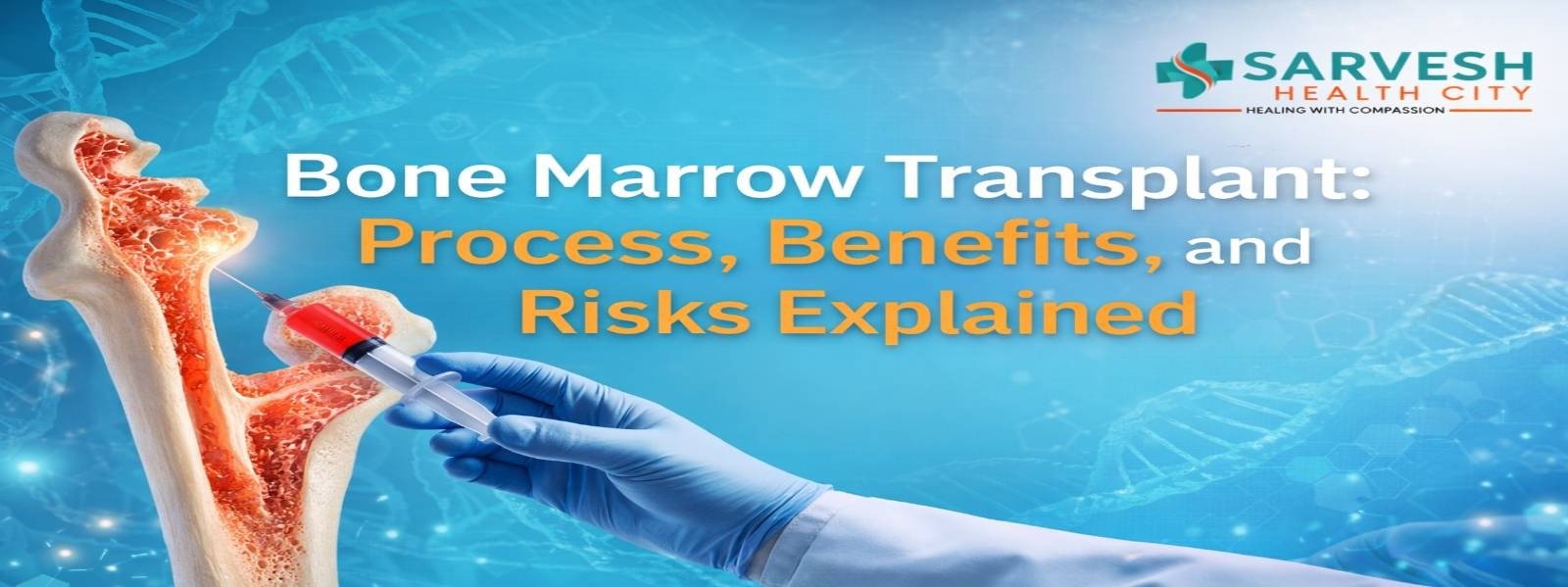
Severe blood diseases and any cancer, have the potential of changing patients and their family’s life drastically. In these situations, a bone marrow transplant can offer a new chance if other treatments could not cure the patient by restoring the normal blood cell production.
For those looking for bone marrow transplant in Hisar, you can rely on top-notch professionals and modern facilities of Sarvesh Health City. It is one of the hospitals that helps in diagnosis and offers the best consultation and treatment options by experts.
What is Bone Marrow and Why It Matters
Bone marrow is the soft, spongy tissue inside bones such as the hips, backbones, and ribs. It is an important part of the body because bone marrow creates stem cells that develops or produces various types of blood cells including white blood cells, red blood cells, and platelets.
If bone marrow is healthy, it regularly supply these blood cells to keep the body going on normaly. On the other hand, certain diseases can harm or even kill bone marrow affecting the ability to produce sufficient blood cells, such as leukemia, lymphoma, aplastic anemia, and immune disorders. In such cases, a bone marrow transplant can be a life saving technique in reestablishing the body’s capacity to produce healthy blood cells.
What Is a Bone Marrow Transplant and its Types?
A bone marrow transplant is a medical procedure that substitutes the diseased or damaged bone marrow with the healthy stem cells. These stem cells then help in generating new and healthy blood cells while also helping in recovery of normal bone marrow function.
It is one of the treatment options generally used by oncologists for the patients whose bone marrow is compromised as a result of cancer or genetic disorder along with certain treatments such as high dose chemotherapy or radiation.
Physicians may recommend a bone marrow transplant for treating leukemia, lymphoma, myeloma, severe aplastic anaemia, and other immune system disorders.
There are so many types of bone marrow transplant, depending on the source of stem cells:
- Autologous Transplant: The process begins with collecting patient’s own stem cells, which are then preserved. After high dose chemotherapy or radiation treatment, these healthy stem cells are placed back in the patient’s body to regenerate the bone marrow.
- Allogeneic Transplant: In this case, the stem cells are received from a donor with proper genetic matching for the patient. The donor can be a brother or sister, other family member, or a volunteer from donor registries.
- Umbilical Cord Blood Transplant: Herein, stem cells are taken from umbilical cord of a baby at birth. These cells are very primitive and can accommodate well, which is why sometimes it requires less strict matching between donor and patient.
The Bone Marrow Transplant Process
Undertaking a bone marrow transplant is a multi-step process that has to be planned to get the most effective results.
Firstly, while trying to find a donor, doctors carefully verify through various medical examinations and tests if the patient can undergo the transplant. Once preparation is done, patients undergo conditioning therapy, which might be chemotherapy, radiation, or a combination of both. It helps to eliminate the disease cells and prepares the body for receiving new stem cells.
After that the next and important step is transplant, where new healthy stem cells are put into the patient’s veins using a central venous catheter, similar to a blood transfusion. The cells make their way to the bone marrow and start producing new blood cells.
Lastly, recovery and close observation comes as the last step. At this point, the medical team closely watches any symptoms of infections and side effects and monitors the growth of new stem cells.
Benefits of Bone Marrow Transplant
There are many ways in which a bone marrow transplant can change a patient’s life for the better. It enables suffering from a serious blood disorder or cancer to recover for a long time and even enjoy a good-quality life. Major benefits are:
- Some diseases can even be cured in the case of bone marrow transplant like leukemia and lymphoma
- Regardless of the disease, damaged bone marrow can be replaced with healthy stem cells
- Immunity that was lost due to cancer or any other disease can be taken care of by bone marrow transplant as it helps body to fight against infection
- Even high-dose chemotherapy or radiation which cause damage to bone marrow can be given to patient without any risk of bone marrow damage if bone marrow transplant is done
- Patients who have undergone bone marrow transplant have long-term survival rates that are better
Besides chemotherapy and radiation treatments, a bone marrow transplant can bring bright future for people who have no other choice but to fight against their disease.
Risks and Possible Complications
Similar to any medical treatment, a bone marrow transplant is a procedure that entails some risks and complications. Being aware of these risks can help patients and their families to get mentally ready for the recovery time.
One of the side effects is graft-versus-host disease (GVHD), which is a condition when the newly introduced donor cells attack the patient’s body tissues. Patients are also prone to getting infections as their immune system is compromised for a while during the treatment.
There are other risks like bleeding, damage to the organs, and in some cases thescenarios where the transplant gets rejected i.e. the body refuses the new stem cells. Furthermore, some patients may feel tired, have nausea or go through other symptoms as well while healing.
Nevertheless, bone marrow transplant has become a safer and more effective option currently owing to the progress in transplant technology, better donor matching and expert medical care.
Final Thoughts
Bone marrow transplant is a seriously complicated yet effective and life-saving procedure that has changed the fate of deadliest blood disorders and cancers. Although the procedure can be intimidating, it is a fact that tons of researches and medical strategies have resulted in creating safer and more effective transplant procedure.
Getting diagnosed early, thoroughly assessing one’s condition, and getting a professional medical advice are all very crucial factors that lead to a successful transplant. If you are thinking of bone marrow transplant in Hisar, then it is a must to consult expert doctors.
In Sarvesh Health City, people get excellent treatment with the help of leading-edge healthcare equipment, and support all through their treatment path.
FAQs
Q1. Who can have a bone marrow transplant?
Ans. A bone marrow transplant is a good option for people with lymphoma, leukemia, aplastic anemia, multiple myeloma, or some immune and genetic system disorders.
Q2. Is a bone marrow transplant very painful?
Ans. A transplant is normally painless as it is like a blood transfusion. But, chemotherapy, radiation, or post-transplant treatments may cause side effects.
Q3. What is the recovery time after a bone marrow transplant?
Ans. It differs from person to person considering the external and internal factors. However, in mot cases, it takes a few months for the immune system to get back to normal and for the body to recover after the transplant operation.
Q4. What are the success rate of bone marrow transplant?
Ans. The success rates depends on patient’s age, type of disease, etc. Besides, the overall health and donor’s compatibility also play an important role. Constant medical progress has resulted in better outcomes.
Media Enquiries
- Sarvesh Health City
- Sarvesh Health City Site No. 1, Sector 14, Hisar – 125001 (Haryana)
- +91 6901 626262
- +91 6901 636363
Social Media
Healthcare at your fingertips



HEMATO-ONCOLOGIST & BONE MARROW TRANSPLANT