- Specialities
- Center of Excellence
- Specialitites
- ANAESTHESIA & INTENSIVIST
- BREAST SURGERY
- CRITICAL CARE
- DERMATOLOGY
- DIALYSIS
- DENTISTRY & MAXILLOFACIAL SURGERY
- ENT
- INTERNAL MEDICINE
- INTERVENTIONAL RADIOLOGY
- LAPAROSCOPIC & GENERAL SURGERY
- OBSTETRICS & GYNAECOLOGY & COSMETOLOGY
- OPHTHALMOLOGY (EYE CARE)
- PEDIATRIC CARE & NEONATOLOGY
- PHYSIOTHERAPY & REHABILITATION
- Services
- AMBULANCE SERVICES (24/7)
- BONE MARROW TRANSPLANT
- BLOOD CENTER (OPEN 24/7)
- EMERGENCY SERVICES (AVAILABLE 24/7)
- LAB AND PATHOLOGY (OPEN 24/7)
- NEONATAL INTENSIVE CARE UNIT (NICU) & PEDIATRIC INTENSIVE CARE UNIT (PICU)
- NUTRITION & DIETETICS
- PHYSIOTHERAPY & REHABILITATION SERVICES
- PREVENTIVE HEALTH CHECKUPS
- PHARMACY (OPEN 24/7)
- PET/CT SCAN
- RADIOLOGY & IMAGING SERVICES
- Blogs
- Health Library
- Our Empanelment
- About Sarvesh
- Specialities
- Center of Excellence
- Specialitites
- ANAESTHESIA & INTENSIVIST
- BREAST SURGERY
- CRITICAL CARE
- DERMATOLOGY
- DIALYSIS
- DENTISTRY & MAXILLOFACIAL SURGERY
- ENT
- INTERNAL MEDICINE
- INTERVENTIONAL RADIOLOGY
- LAPAROSCOPIC & GENERAL SURGERY
- OBSTETRICS & GYNAECOLOGY & COSMETOLOGY
- OPHTHALMOLOGY (EYE CARE)
- PEDIATRIC CARE & NEONATOLOGY
- PHYSIOTHERAPY & REHABILITATION
- Services
- AMBULANCE SERVICES (24/7)
- BONE MARROW TRANSPLANT
- BLOOD CENTER (OPEN 24/7)
- EMERGENCY SERVICES (AVAILABLE 24/7)
- LAB AND PATHOLOGY (OPEN 24/7)
- NEONATAL INTENSIVE CARE UNIT (NICU) & PEDIATRIC INTENSIVE CARE UNIT (PICU)
- NUTRITION & DIETETICS
- PHYSIOTHERAPY & REHABILITATION SERVICES
- PREVENTIVE HEALTH CHECKUPS
- PHARMACY (OPEN 24/7)
- PET/CT SCAN
- RADIOLOGY & IMAGING SERVICES
- Blogs
- Health Library
- Our Empanelment
- About Sarvesh
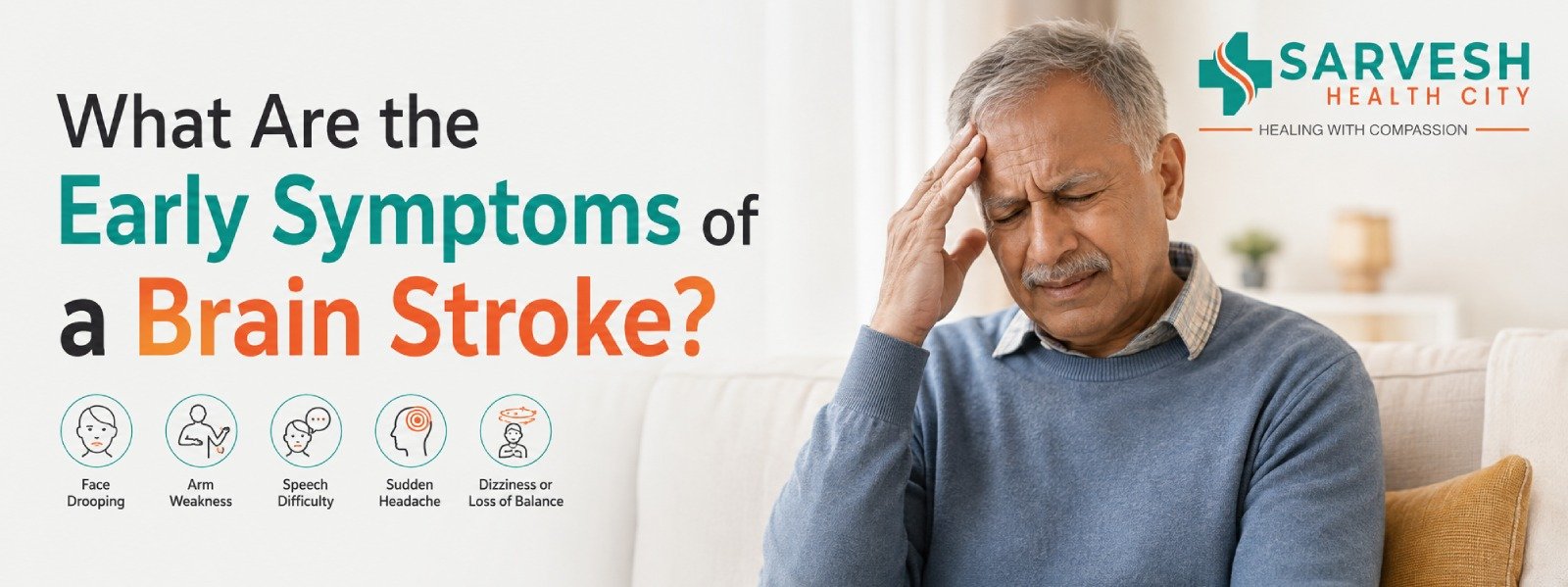
Brain stroke is an extreme situation that calls for immediate medical help. When a stroke occurs, brain cells are not supplied with oxygen and nutrients, and the chances of irreversible brain injury, disability, or even death go up with every minute that passes. Identifying early symptoms of a stroke and consulting with a doctor can help boost your chances of recovery as well as save you from long-term disabilities.
Sarvesh Health City and the neurology team strongly advise their patients that getting treated at the earliest can improve the brain health and overall quality of life. Choosing the best neurology hospital in Hisar, timely diagnosis, quick access to advanced stroke treatment, plays a crucial role in achieving the best possible outcomes.
Quick Facts About Brain Stroke
- What is a Brain Stroke?
Brain stroke is when a part receives interrupted or reduced blood flow, resulting in dead brain cells.
- Main Brain Stroke Types
Ischemic stroke, transient ischemic attack, and hemorrhagic stroke are the common stroke types.
- Most Common Symptoms
Sudden weakness, uneven facial expression, slurred speech, changes in vision, and dizziness.
What Happens During a Brain Stroke?
Knowing about brain stroke mechanism is helpful before you equip yourself with identifying its symptoms.
A brain stroke happens when the part of the brain does not receive blood supply either because it is blocked or the amount of blood getting there is reduced. Brain cells then suffer because they stop getting adequate nutrition and oxygen.
There are mainly two kinds of strokes as:
- Ischemic Stroke is the common one that happens when the artery carrying blood to brains is blocked by a clot.
- Hemorrhagic Stroke, which results from a ruptured blood vessel situated in brain.
If not identified and treated quickly, the outcome of the two types will be the same that brain cells will start dying within minutes. Due to this very reason, identifying symptoms and beginning life-saving treatment early is very crucial for saving the patient’s life.
The BE-FAST Framework: Recognizing Early Symptoms
The FAST method for stroke symptoms detection has been around for years. But in the recent times, a newer screening method called the BE-FAST test is around, which gives inclusive and thorough screening for early detection of stroke symptoms and no one should ignore any of the below symptoms:
B – Balance: A sudden loss of body movement and balance
E – Eyes: Sudden change of vision
F – Face: Facial drooping or smile has become uneven
A – Arms: Numbness or weakness in single arm
S – Speech: Slurred speech or difficulty while speaking
T – Time: Contact emergency medical services straight away
The Early Signs of a Brain Stroke
Symptoms of stroke typically show up without warning and very quickly. Even though each stroke may present differently, being able to recognize these clues may save your available time.
- Sudden Weakness or Numbness: A stroke’s initial indicator is often unexpected weakness, numbness, or lack of control of one side of a person’s face, an arm or a leg. The person may discover that one arm is difficult for them to lift or that they have a feeling of heaviness or numbness on one side of the face.
- Facial Drooping: A drooping smile is a classic symptom of a stroke which shows up when a person smiles and one side of the face appears uneven or droops.
- Having Trouble Speaking or Understanding Speech: One’s ability to speak might become very impaired suddenly like it was slurred, garbled or difficult to comprehend. Other stroke victims might be able to speak, but they have difficulties coming up with words or are confused when others speak to them even though they seem to be very alert.
- Sudden Vision Changes: A stroke may cause one or both eyes to become suddenly unable to see properly. The patient may have blurry vision, seeing double images, or only seeing a part of one side.
- Loss of Balance or Coordination: The person may be very dizzy, unable to walk or completely disoriented. This kind of stroke affects your brain’s balance center. A person falling for no visible reason is a matter of concern, which indicates it could be a stroke.
- Severe Sudden Headache: Usually, a stroke that causes bleeding has been described as the ‘worst headache’ and it can come with a vomiting, confusion, or changes in the vision.
Less Common Symptoms That Should Not Be Ignored
Not all stroke patients show similar signs such as drooping or speech difficulty. In fact, some women, elders, and diabetic patients tend to show atypical or mild symptoms that include:
- A sudden onset of confusion or disorientation
- Problems swallowing, which is a warning sign to pay attention to
- Spontaneous feeling of nausea or vomiting indicates a stroke
- Extreme fatigue or tiredness with no reason
- Sudden changes in alertness or level of consciousness
These symptoms are also part of other medical problems, which makes it easy to ignore that it could be a brain stroke. If one of the mentioned symptoms occurs suddenly, especially in combination with a weakness or impaired speech, it would be best to go for a medical checkup immediately.
What To Do If Someone Shows Stroke Symptoms?
Everyone should be aware of stroke signs and know the plan of action. When you see these symptoms in your close environment, you should always be prepared as it might be the only chance that someone saves a life:
- Call emergency medical assistance immediately.
- Note the Time: Doctors will need to know precisely when the symptoms first appeared because only in some circumstances, they can use clot-busting drugs (tPA) like.
- Positioning: It would be best to place the person in the right position, on their side, so if they throw up, they won’t choke.
- Avoid Medication: Don’t give the person aspirin or other medications. Aspirin might worsen bleeding if it is a hemorrhagic stroke.
- Stay Calm: Try to calm down the patient to help them keep their blood pressure from rising.
Final Thoughts
Brain strokes can strike without any warning, yet identifying initial symptoms can have a huge positive impact. The sooner the stroke treatment begins, the better the chances are for a person to recover fully. Brain cells can be saved from dying, and future disability avoided. It is essential that people know these signs, do not hesitate, and get help if they suspect something is wrong.
If you are looking for the best neurology hospital in Hisar, our multidisciplinary team is fully dedicated to delivering fast, neurological care based on current guidelines with early treatment followed by long-term rehabilitation.
Frequently Asked Questions
Q1. Is a mini-stroke the same as a brain stroke?
Ans. Mini-stroke (TIA) means a transient brain attack. It happens when the temporary block of the blood flow to the brain causes very similar symptoms to that of actual stroke. Though the symptoms fade pretty quickly, TIA is a serious indicator that immediate medical attention is needed.
Q2. How quickly should stroke treatment begin?
Ans. Medical care has to be fast. Clot-buster therapies for the brain stroke are most effective if they are taken within a few hours from the moment that the stroke symptoms occur. Because of this reason, it is necessary to get hospitalized right away.
Q3. Can a stroke occur without severe headache?
Ans. It can happen. Headaches are a very unlikely symptom of ischemic strokes in the majority. Usually, a person suddenly becomes weak, speech is difficult, face droops, or vision in one or both eyes is not working. Besides, balance may also be lost. Severe headaches are more frequent in brain hemorrhages.
Q4. What’s the biggest risk for brain stroke?
Ans. The main factor which triggers strokes is high blood pressure. Apart from that diabetes and cholesterol also plays a major role.
Q5. Can people improve completely after having a stroke?
Ans. The outcome of the illness relies on the stroke type, the brain part which got damaged, the speed of delivery of medicine. When treatment is timely followed by rehabilitation, recovery is much better, and the patient’s life is considerably improved.
Media Enquiries
- Sarvesh Health City
- Sarvesh Health City Site No. 1, Sector 14, Hisar – 125001 (Haryana)
- +91 6901 626262
- +91 6901 636363
Social Media
Healthcare at your fingertips


Chairman & Senior Neurosurgeon
Best Neurosurgeon in Hisar – Dr. Umesh Kalra, providing expert care at Sarvesh Health City for neurological treatments.