- Specialities
- Center of Excellence
- Specialitites
- ANAESTHESIA & INTENSIVIST
- BREAST SURGERY
- CRITICAL CARE
- DERMATOLOGY
- DIALYSIS
- DENTISTRY & MAXILLOFACIAL SURGERY
- ENT
- INTERNAL MEDICINE
- INTERVENTIONAL RADIOLOGY
- LAPAROSCOPIC & GENERAL SURGERY
- OBSTETRICS & GYNAECOLOGY & COSMETOLOGY
- OPHTHALMOLOGY (EYE CARE)
- PEDIATRIC CARE & NEONATOLOGY
- PHYSIOTHERAPY & REHABILITATION
- Services
- AMBULANCE SERVICES (24/7)
- BONE MARROW TRANSPLANT
- BLOOD CENTER (OPEN 24/7)
- EMERGENCY SERVICES (AVAILABLE 24/7)
- LAB AND PATHOLOGY (OPEN 24/7)
- NEONATAL INTENSIVE CARE UNIT (NICU) & PEDIATRIC INTENSIVE CARE UNIT (PICU)
- NUTRITION & DIETETICS
- PHYSIOTHERAPY & REHABILITATION SERVICES
- PREVENTIVE HEALTH CHECKUPS
- PHARMACY (OPEN 24/7)
- PET/CT SCAN
- RADIOLOGY & IMAGING SERVICES
- Blogs
- Health Library
- Our Empanelment
- About Sarvesh
- Specialities
- Center of Excellence
- Specialitites
- ANAESTHESIA & INTENSIVIST
- BREAST SURGERY
- CRITICAL CARE
- DERMATOLOGY
- DIALYSIS
- DENTISTRY & MAXILLOFACIAL SURGERY
- ENT
- INTERNAL MEDICINE
- INTERVENTIONAL RADIOLOGY
- LAPAROSCOPIC & GENERAL SURGERY
- OBSTETRICS & GYNAECOLOGY & COSMETOLOGY
- OPHTHALMOLOGY (EYE CARE)
- PEDIATRIC CARE & NEONATOLOGY
- PHYSIOTHERAPY & REHABILITATION
- Services
- AMBULANCE SERVICES (24/7)
- BONE MARROW TRANSPLANT
- BLOOD CENTER (OPEN 24/7)
- EMERGENCY SERVICES (AVAILABLE 24/7)
- LAB AND PATHOLOGY (OPEN 24/7)
- NEONATAL INTENSIVE CARE UNIT (NICU) & PEDIATRIC INTENSIVE CARE UNIT (PICU)
- NUTRITION & DIETETICS
- PHYSIOTHERAPY & REHABILITATION SERVICES
- PREVENTIVE HEALTH CHECKUPS
- PHARMACY (OPEN 24/7)
- PET/CT SCAN
- RADIOLOGY & IMAGING SERVICES
- Blogs
- Health Library
- Our Empanelment
- About Sarvesh
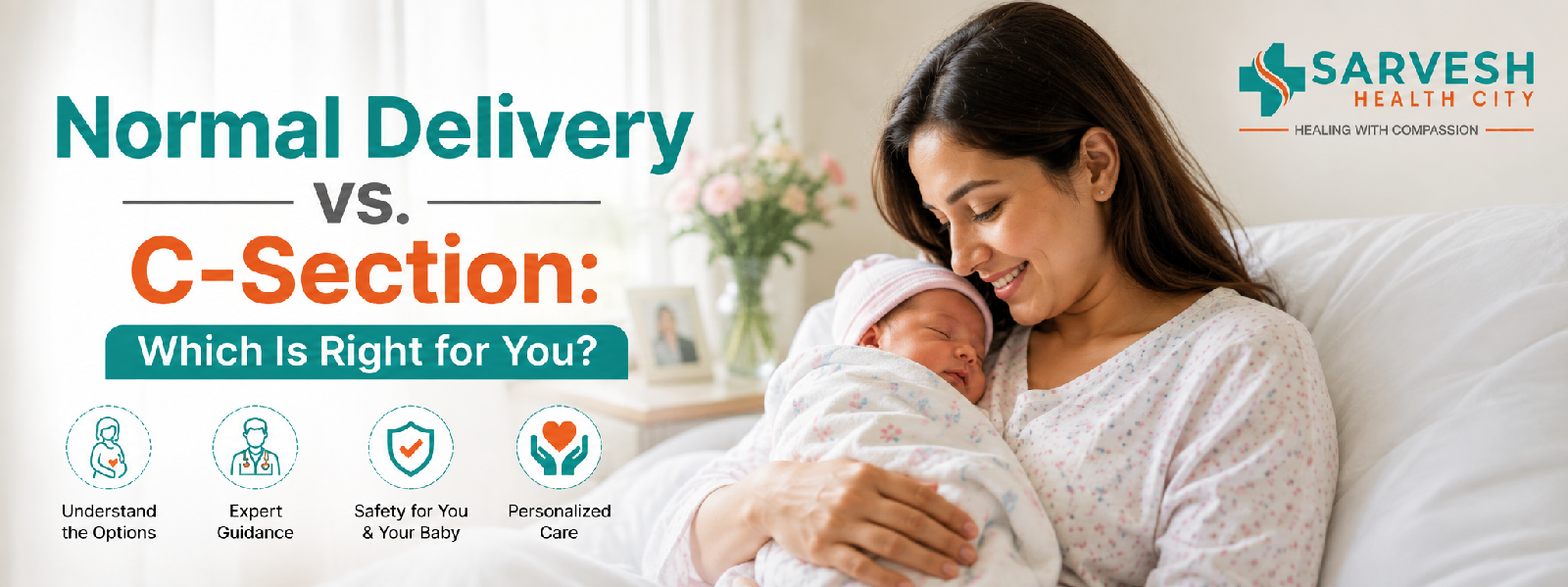
A positive pregnancy test is the first step to the beautiful phase of having a baby, but at the same time, it brings along many vital decisions one has to make like delivery of the baby. Usually, expectant mothers are curious about the question if natural or Cesarean delivery is the better way. To be honest, no single answer suits all pregnancies. The safest mode of birth is usually dependent on the state of health of the mother, status of the baby, and how the pregnancy progresses.
As best gynecology hospital in hisar the gynecologists at the Sarvesh Health City highly recommend personalized care to each of the pregnancies and encourage you to know well about normal delivery and C-section before you choose. This way you will be equipped with good knowledge for making decisions.
Quick Facts About Normal Delivery vs. C-Section
- What is Considered Normal Delivery?
The baby is delivered through the birth canal without abdominal surgery. - What is C-Section?
A surgical procedure used when normal delivery is risky or medically unsuitable. - How Much Recovery Time Is Required in Both?
Normal delivery usually has a quicker recovery, while a C-section requires more healing time. - Does High-Risk Pregnancy Have a Chance of Normal Delivery?
Yes, if the mother’s health, baby’s condition, and gynecologist allows it.
Understanding Normal Delivery and Its Benefits
Normal (vaginal) delivery is the process of delivery in which the child is delivered naturally through the birth canal. For a majority of healthy pregnancies the most likely option of the doctor, and the woman herself is normal delivery since this involves no major operations and is least invasive.
Benefits of Normal Delivery:
- Less likely to face surgical complications and the amount of blood loss is also relatively lesser.
- Early return to normal daily activities
- Baby’s get the lung fluids out more quickly which supports baby to breathe easily.
- Bacterium from vaginally-born infants helps them build stronger immune systems.
When Is a C-Section Recommended?
A C-section is not something that most people would prefer, but when a vaginal birth could be dangerous for mother or child, the safest option would probably be a C-section.
Some procedures are scheduled in advance after detailed assessment whereas some are done as an emergency when labor is going on and complications unexpectedly develop.
Some circumstances in which your obstetrician might recommend a C-section includes:
- Baby is in breech or transverse position
- Placenta previa (placenta covering the cervix)
- Fetal distress during labor
- Failure of labor to progress
- Umbilical cord complications
- Multiple pregnancies in certain situations
- Previous uterine surgery where vaginal birth is unsafe
- Certain maternal medical conditions, including severe preeclampsia
In most of these cases a well-timed C-section can save both mother and baby.
Can a High-Risk Pregnancy Have a Normal Delivery?
There are lots of instances where pregnant women with high risk factors manage to give birth normally, and C-section is by no means a guaranteed outcome for such pregnancies. The choice of delivery mode depends upon multiple factors such as mothers’ general condition, the development of a baby, its position at birth, gestational age, and the labor condition at a given time.
Women with carefully managed type 2 diabetes, hypertension, or advanced age might still have a normal delivery if the situation is monitored medically all the time. Whereas a condition like placenta previa, pre-ecclampsia, fetal distress, or specific multiple pregnancies can result in planning a C-section as a much safer route.
Recovery After Normal Delivery vs. C-Section: What Should You Expect?
How the mother recovers after delivery depends upon her health and type of delivery. While a normal delivery allows quicker physical recovery, the C-section is a major surgery and will take longer to recover from.
1. Recovery After Normal Delivery
In general the mother will recover quicker after a normal delivery as there is no abdominal surgery involved. Normally, the mother will be able to start walking just few hours after her baby has been born which would be helpful in the recovery as she would benefit from the increased blood circulation.
Although she could be suffering from the mild soreness, vaginal bleeding, or discomfort around the stitched area, these are normal, and symptoms usually subside in the next few days.
A typical recovery for most moms includes:
- Short hospital stay (only 24, 48 hours long)
- Progressive decrease of pain and discomfort over months after childbirth
2. Recovery After C-Section
Since a C-section involves significant abdominal surgery, it is expected that recovering will be a bit longer compare to a normal delivery. Although most mothers are advised to get up, move, and walk about after 12-24 hours the surgery to maintain the blood moving, and avoid blood clot formation, the complete healing of the uterus and the abdominal incision typically take about 6 – 8 weeks.
It is normal to experience wound area pain, difficulty sitting up, or getting out of bed, plus, fatigue, in the beginning days. As the healing continues, you will gradually get back to the state where you can perform most activities on a daily basis.
To help quick healing after a C-section, mothers are recommended to:
- Keep the surgical site clean and dry.
- Follow the prescribed schedule to use painkillers and antibiotics.
- Consume high protein food and stay hydrated.
- Educate yourself on maintaining physical activity to improve blood circulation.
- Have regular follow-up visits as advised.
What’s Best Between Normal Delivery and C-Section?
A lot of people are curious whether they can be the one who decides which childbirth method is best.
In healthy pregnancy, a mother is likely to deliver normally because her doctor understands that the vaginal delivery route is safe for the mom and baby and takes less time.
On the other hand, doctor advises a C-section when pregnancy or a birth gets complicated, because that’s the safer choice for the mother and her baby.
Also remember that the best decision comes by communicating over medical records, development of the fetus during pregnancy, and other risks with the health care provider.
Final Thoughts
Each pregnancy is a completely different experience, and there is no one-size-fits-all method for giving birth. A normal delivery is usually recommended by gynaecologists since it allows the mother to recover fast and has lower risk of surgical complications. However, sometimes C-section is the recommended delivery method when the mother or baby’s health is in danger because of the various medical circumstances.
Instead of trying to choose the delivery method, expectant parents should be more focused on getting good antenatal care, visiting, and maintaining a good communication with their healthcare provider in best gynecology hospital in Hisar that can help in safe childbirth process.
Frequently Asked Questions
Q1. Is normal delivery possible after a previous C-section?
Ans. Yes, normal delivery is definitely possible, but that depends on reason for previous C-section and the current pregnancy status.
Q2. Does a positive pregnancy test mean I should immediately visit a gynecologist?
Ans. If you have pregnancy test that turned out positive, the first step would be to get in touch with a well-equipped maternity hospital to consult with the leading gynecologists of the city to plan for the rest of your pregnancy journey, the necessary precautions and so on.
Q3. Will a high-risk pregnancy always require a C-section?
Ans. Even a high risk pregnancy also often gets permitted to normal delivery. So, overall the method of delivery is decided by the condition of the mother at the given time along with the risks for the baby.
Q4. How can I improve my chances of having a normal delivery?
Ans. You can maintain a chance of healthy pregnancy by following the healthy routine, opting for a balanced diet, regular checkups from the day of conceiving and maintaining proper weight.
Q5. When should I go to the hospital once labor begins?
Ans. If you are feeling regular contractions and pain, your water breaks, fetal movement has reduced, vaginal bleeding or sudden pain, you must visit hospital.
Media Enquiries
- Sarvesh Health City
- Sarvesh Health City Site No. 1, Sector 14, Hisar – 125001 (Haryana)
- +91 6901 626262
- +91 6901 636363
Social Media
Healthcare at your fingertips



CO-CHAIRMAN & SR. OBSTETRICIAN AND GYNAECOLOGIST
Meet Dr. Sarita Kalra, Co-Chairman & Sr. Gynaecologist, trusted by thousands for expert care in women’s health. Book your appointment today!