- Specialities
- Center of Excellence
- Specialitites
- ANAESTHESIA & INTENSIVIST
- BREAST SURGERY
- CRITICAL CARE
- DERMATOLOGY
- DIALYSIS
- DENTISTRY & MAXILLOFACIAL SURGERY
- ENT
- INTERNAL MEDICINE
- INTERVENTIONAL RADIOLOGY
- LAPAROSCOPIC & GENERAL SURGERY
- OBSTETRICS & GYNAECOLOGY & COSMETOLOGY
- OPHTHALMOLOGY (EYE CARE)
- PEDIATRIC CARE & NEONATOLOGY
- PHYSIOTHERAPY & REHABILITATION
- Services
- AMBULANCE SERVICES (24/7)
- BONE MARROW TRANSPLANT
- BLOOD CENTER (OPEN 24/7)
- EMERGENCY SERVICES (AVAILABLE 24/7)
- LAB AND PATHOLOGY (OPEN 24/7)
- NEONATAL INTENSIVE CARE UNIT (NICU) & PEDIATRIC INTENSIVE CARE UNIT (PICU)
- NUTRITION & DIETETICS
- PHYSIOTHERAPY & REHABILITATION SERVICES
- PREVENTIVE HEALTH CHECKUPS
- PHARMACY (OPEN 24/7)
- PET/CT SCAN
- RADIOLOGY & IMAGING SERVICES
- Blogs
- Health Library
- Our Empanelment
- About Sarvesh
- Specialities
- Center of Excellence
- Specialitites
- ANAESTHESIA & INTENSIVIST
- BREAST SURGERY
- CRITICAL CARE
- DERMATOLOGY
- DIALYSIS
- DENTISTRY & MAXILLOFACIAL SURGERY
- ENT
- INTERNAL MEDICINE
- INTERVENTIONAL RADIOLOGY
- LAPAROSCOPIC & GENERAL SURGERY
- OBSTETRICS & GYNAECOLOGY & COSMETOLOGY
- OPHTHALMOLOGY (EYE CARE)
- PEDIATRIC CARE & NEONATOLOGY
- PHYSIOTHERAPY & REHABILITATION
- Services
- AMBULANCE SERVICES (24/7)
- BONE MARROW TRANSPLANT
- BLOOD CENTER (OPEN 24/7)
- EMERGENCY SERVICES (AVAILABLE 24/7)
- LAB AND PATHOLOGY (OPEN 24/7)
- NEONATAL INTENSIVE CARE UNIT (NICU) & PEDIATRIC INTENSIVE CARE UNIT (PICU)
- NUTRITION & DIETETICS
- PHYSIOTHERAPY & REHABILITATION SERVICES
- PREVENTIVE HEALTH CHECKUPS
- PHARMACY (OPEN 24/7)
- PET/CT SCAN
- RADIOLOGY & IMAGING SERVICES
- Blogs
- Health Library
- Our Empanelment
- About Sarvesh
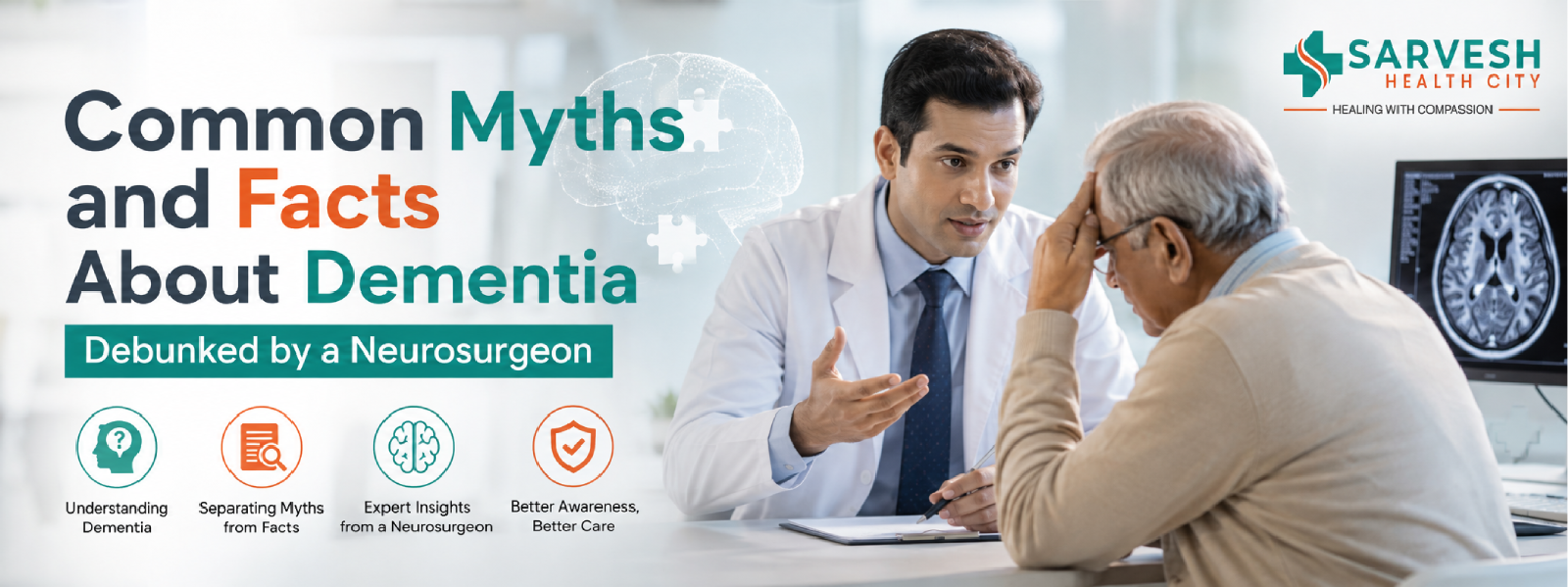
Dementia is a condition that many people fear or have wrong information. Many people assume that memory loss is just a part of getting older, whereas others think that if it is diagnosed, they can not do anything anymore. The reality, however, truth is far more encouraging. By learning common myths and facts about dementia, families could pick up early signs of disease, get timely treatment, and improve the life quality.
We at Sarvesh Health City, with our neurology and neurosurgery teams help make the diagnosis, plan treatment, and deliver care with personalization and sensitivity. If you are looking for best neurosurgeon in Hisar, knowing about dementia beforehand can help you consult with top neurologist and prevent developing brain disease.
Quick Facts About Dementia
-
What is Dementia?
A brain condition that affect memory, thinking, behavior, and the ability to perform daily activities. -
Is Dementia Normal Ageing?
No. Dementia is not a normal part of ageing and should always be medically evaluated. -
Common Types of Dementia
Alzheimer’s disease is the most common, among others like vascular dementia and lewy body dementia.
Common Myths and Facts About Dementia
Dementia is a set of various symptoms that results from brain disorders. Over time, it affects memory, thinking, language, and behavior. In fact, memory and the ability to do everyday things are also compromised. However, wrong knowledge can hinder the process of diagnosis and keep the families from getting timely care. Let’s look at popular myths vs. medical truth.
Myth 1: Dementia Is Simply Something That Comes with Old Age
Fact:
Although it may happen when one gets older they occasionally forgets something like keys or names, dementia is a different thing altogether.
Dementia patients go through changes which gradually disrupt their daily functioning. They may be completely unable to find the way to the supermarket although it is next door or not recognizing a beloved one.
Constant memory issues which make one feel incapable of doing a thing should be checked by a neurologist as there may be a real disease behind them and one may not just label it as a result of “ageing.”
Myth 2: Alzheimer’s Disease and Dementia Are Similar
Fact:
Mostly both these words are used interchangeably; however, neurosurgery and clinical medicine see a very substantial difference between these diseases. Dementia is referred to a range of mental deterioration symptoms. On the contrary, Alzheimer’s disease is the most common type of dementia.
Vascular Dementia (a result of lack of sufficient blood supply to the brain), Lewy Body Dementia, and Frontotemporal Dementia are amongst others types of dementia. Each of these have different triggers, involve a different part of the brain, and the treatment methods also differ.
Myth 3: Nothing Can Be Done After a Dementia Diagnosis
Fact:
While it is true that many forms of neurodegenerative dementia are currently irreversible, the statement that “nothing can be done” is dangerously false. There are two critical reasons for this, one is if it is treatable “pseudo-dementias” and the other is how well the symptoms are managed.
For instance, severe B12 deficiency. The same is with hypothyroidism or NPH (Normal Pressure Hydrocephalus) and specific types of brain tumors which can manifest as cognitive declines. If an NPH case is recognized then a brain surgeon is able even to make a shunt operation to drain excess cerebrospinal fluid. Most often after this brain surgery there is an improvement in cognitive functions and mobility as well.
Proper evaluation can identify these reversible causes and allow appropriate treatment.
Myth 4: Dementia Only Affects Memory
Fact:
Dementia is thought to be the problem that only old person has it where they can’t remember their grandchild’s or spouse’s name. But memory loss is just a little part of what happens in people with dementia. A bigger picture of dementia is when the “executive brain function” goes off, which was handled by the frontal lobe.
Many people with dementia exhibit the following problems:
- Personality Changes: If someone was always a peaceful person, he could start doing things differently.
- Disorientation: Forgetting the time, date, and even where one is.
- Language Problems (Aphasia): Either struggling to find the correct words or not able to talk or write.
- Loss of Judgement: Not recognizing things or understanding situations.
Getting to see that the way of behaving differently is a symptom of brain disease rather than some sort of “bad behaviour,” helps caregivers treat the person with more kindness and understanding.
Myth 5: Only Elderly People Develop Dementia
Fact:
In the general population dementia is more frequently diagnosed in old age after 65, but the condition is not exclusive to that age group, as people of all age groups may experience dementia, especially early-onset dementia.
Young-onset dementia may result from:
- Genetic disorders
- Brain injuries
- Neurological diseases
- Certain inherited conditions
The problem arises when people dismiss the symptoms because they think the person is too young, resulting in a delay in the doctor’s visit and the start of treatment.
Myth 6: Memory Loss Always Means Dementia
Fact:
Forgetfulness doesn’t necessarily signify dementia.
Memory issues could be due to:
- Stress
- Anxiety
- Depression
- Bad sleep
- Pills
- Vitamin deficiencies
A proper neurological assessment allows experts to find out if memory loss is natural and age related, temporary, or dementia induced.
Final Thoughts
Dementia not only impacts the patient but also their family members. However, it is important to know that knowing facts about dementia and the illness can make a huge difference. Unfortunately, many myths about this condition prevent people from being diagnosed early, and they get scared, leading to delay for getting the treatment.
Being aware of the symptoms of illness, and visiting the best neurosurgeon in Hisar for confirmation early are the ways to slow down the loss of independence and even enhance the overall quality of life.
Sarvesh Health City provides complete neurological care through modern diagnostic tools and expert neurosurgery consultancy. The hospital additionally offers emotional support to people with dementia through proper counseling and early intervention.
Frequently Asked Questions
Q1. What is usually the first sign of dementia?
Ans. Usually, memory deficits are the very first manifestation, especially forgetting new information. Some individuals might initially notice that the judgment, language or behavior have changed.
Q2. Can dementia be diagnosed with a brain scan alone?
Ans. No. The brain scans MRI/CT are able to pinpoint the areas of structural change and can sometimes be used to eliminate other conditions. In combination with the patient’s history, neurological exam, and cognitive testing, doctors will make an official diagnosis.
Q3. Is dementia hereditary?
Ans. Genetics can be the cause in few cases of rare forms of dementia, however most of dementia cases are caused by a blend of aging, lifestyle factors and general condition of your brain.
Q4. Can people with dementia continue living independently?
Ans. Many people who are in the very initial stage of the illness and who receive adequate treatment, family care and are able to adjust their lifestyle may still be able to continue living independently. However, if the condition deteriorates further, it may be difficult for the person to manage on their own and would need help and support.
Q5. When should someone with memory problems consult a specialist?
Ans. If the memory issues are getting worse and also affecting the normal routine tasks of the individual like their behaviour, language difficulty or getting lost then it is necessary to consult the expert. As memory loss gets worse, consulting a doctor can help in identifying dementia symptoms and initiating treatment early on.
Media Enquiries
- Sarvesh Health City
- Sarvesh Health City Site No. 1, Sector 14, Hisar – 125001 (Haryana)
- +91 6901 626262
- +91 6901 636363
Social Media
Healthcare at your fingertips


Chairman & Senior Neurosurgeon
Best Neurosurgeon in Hisar – Dr. Umesh Kalra, providing expert care at Sarvesh Health City for neurological treatments.