- Specialities
- Center of Excellence
- Specialitites
- ANAESTHESIA & INTENSIVIST
- BREAST SURGERY
- CRITICAL CARE
- DERMATOLOGY
- DIALYSIS
- DENTISTRY & MAXILLOFACIAL SURGERY
- ENT
- INTERNAL MEDICINE
- INTERVENTIONAL RADIOLOGY
- LAPAROSCOPIC & GENERAL SURGERY
- OBSTETRICS & GYNAECOLOGY & COSMETOLOGY
- OPHTHALMOLOGY (EYE CARE)
- PEDIATRIC CARE & NEONATOLOGY
- PHYSIOTHERAPY & REHABILITATION
- Services
- AMBULANCE SERVICES (24/7)
- BONE MARROW TRANSPLANT
- BLOOD CENTER (OPEN 24/7)
- EMERGENCY SERVICES (AVAILABLE 24/7)
- LAB AND PATHOLOGY (OPEN 24/7)
- NEONATAL INTENSIVE CARE UNIT (NICU) & PEDIATRIC INTENSIVE CARE UNIT (PICU)
- NUTRITION & DIETETICS
- PHYSIOTHERAPY & REHABILITATION SERVICES
- PREVENTIVE HEALTH CHECKUPS
- PHARMACY (OPEN 24/7)
- PET/CT SCAN
- RADIOLOGY & IMAGING SERVICES
- Blogs
- Health Library
- Our Empanelment
- About Sarvesh

- Specialities
- Center of Excellence
- Specialitites
- ANAESTHESIA & INTENSIVIST
- BREAST SURGERY
- CRITICAL CARE
- DERMATOLOGY
- DIALYSIS
- DENTISTRY & MAXILLOFACIAL SURGERY
- ENT
- INTERNAL MEDICINE
- INTERVENTIONAL RADIOLOGY
- LAPAROSCOPIC & GENERAL SURGERY
- OBSTETRICS & GYNAECOLOGY & COSMETOLOGY
- OPHTHALMOLOGY (EYE CARE)
- PEDIATRIC CARE & NEONATOLOGY
- PHYSIOTHERAPY & REHABILITATION
- Services
- AMBULANCE SERVICES (24/7)
- BONE MARROW TRANSPLANT
- BLOOD CENTER (OPEN 24/7)
- EMERGENCY SERVICES (AVAILABLE 24/7)
- LAB AND PATHOLOGY (OPEN 24/7)
- NEONATAL INTENSIVE CARE UNIT (NICU) & PEDIATRIC INTENSIVE CARE UNIT (PICU)
- NUTRITION & DIETETICS
- PHYSIOTHERAPY & REHABILITATION SERVICES
- PREVENTIVE HEALTH CHECKUPS
- PHARMACY (OPEN 24/7)
- PET/CT SCAN
- RADIOLOGY & IMAGING SERVICES
- Blogs
- Health Library
- Our Empanelment
- About Sarvesh
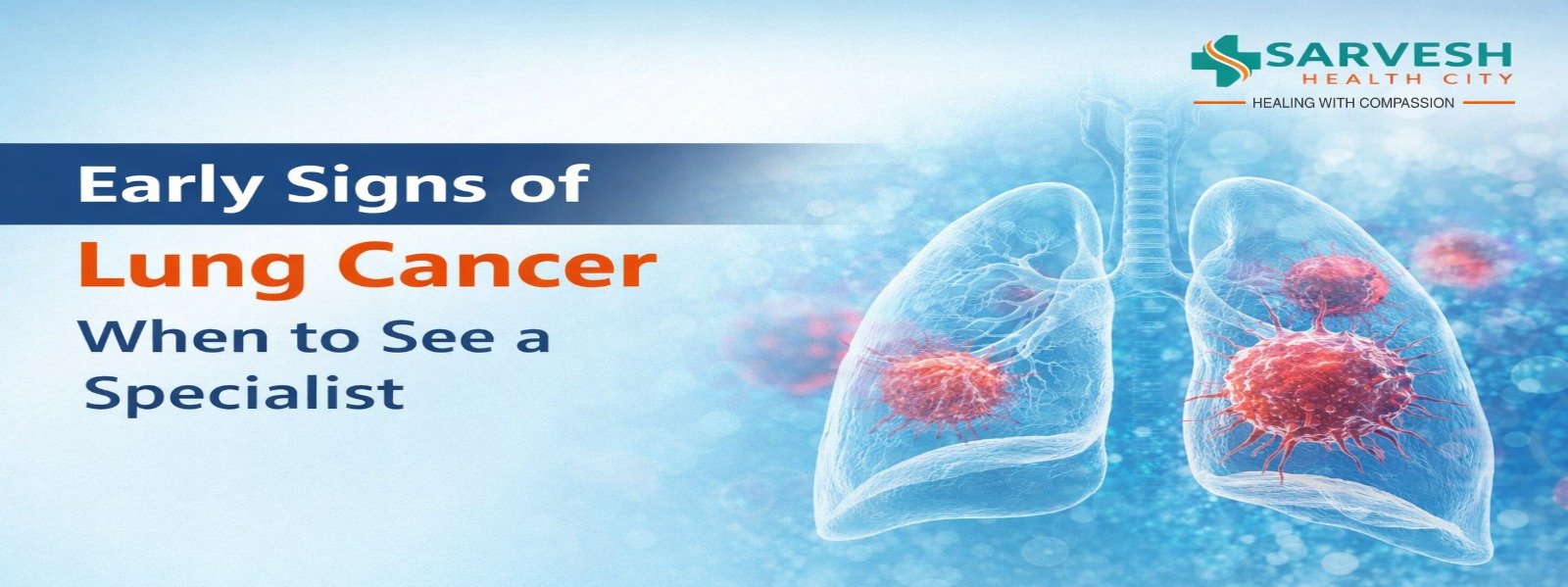
Lung cancer usually progresses silently, without any obvious symptoms, so it is very easy to miss it until it is at a late stage. Also, it is not only smokers that are at risk of it, non-smokers can also be in danger. Identifying the first symptoms can help in timely intervention, change panic to prompt action, and save a life.
This article will explain the lung cancer symptoms that your body may be giving you, and explain when it is the right time to visit the best pulmonology treatment hospital in Hisar. At Sarvesh Health City, recognizing and diagnosing the disease at an early stage is the first step to expert treatment.
Why Early Detection of Lung Cancer Is Challenging
Lung cancer is often labeled a “silent disease” because it doesn’t show symptoms. Initially, it doesn’t even set off any symptoms at all, and if it does, the signs could be so slight that they might be easily confused with the symptoms of a cold, allergies or just tiredness.
Because there are fewer nerve endings in lungs, the lung cancer symptoms such as pain or discomfort may not be strong enough to be detected very early. People easily ignore mild coughs, shortness of breath or any minor cold issues as they are very natural and frequent in our everyday life. Since symptoms and warning signs get delayed in being diagnosed, it makes detecting lung cancer at its early stage challenging.
Early Signs of Lung Cancer You Should Not Ignore
Although the first symptoms may be small or apparently unrelated, your body is usually giving you signals subtly when something is wrong. Being aware of these changes may help you find lung cancer while it is still at an early stage and easily curable.
- A Long-lasting Cough: The most typical symptom is a cough that persists for a long time without disappearing or that gradually gets worse. It can be a little irritating at first, but then you find yourself coughing very often or severely. Also, if your cough changes, for example, becomes deeper or more intense that is a reason for concern.
- Changes in an Existing Cough or Coughing Up Blood: Besides coughing, a very important sign is the case of coughing up small amounts of blood or rust-colored sputum. This symptom can certainly indicate lung irritation or damage in the lungs.
- Chest Pain: If the chest pain intensifies upon taking deep breaths, coughing, or laughing, it might be a sign of lung inflammation or pressure.
- Shortness of Breath, Wheezing: you could notice that breathing is really difficult, sometimes even during small activities, like climbing stairs. Physically, breathing can be difficult and, on occasion, you might hear yourself wheezing or producing a high-pitched sound during breathing, even if you haven’t got any previous history of asthma or any other respiratory problem.
- Hoarseness: A minor but obvious sign is if your voice becomes hoarser or there’s a change in it. A strain or hoarseness in a voice for several weeks, indicates the pressure on the nerves responsible for the vocal cords, impacting your voice.
- Unexplained Weight Loss & Loss of Appetite: You might not realize it, but lung cancer can seriously affect you physically. Unintentional weight loss and decreased appetite are common signs when the body is under strain from an illness. Additionally, if you feel physically weak and exhausted all the time and not recovering with rest could also mean that your body is under stress.
- Recurrent Chest Infections: Experiencing respiratory infections such as bronchitis or pneumonia several times can be a sign that there is a problem with your lungs. These continuous infections can be a sign that your lung function is being compromised.
- Finger Clubbing (Less Common): A few people develop a condition called clubbing of fingers where the fingertips become larger or the nails bend downwards. Even though this is a rare symptom, it is sometimes linked to chronic lung problems including cancer.
Separately these are minor symptoms that few would worry about, however, if they persist, get worse, or appear together, you should not overlook them. Your body’s signals and a timely help of a doctor can greatly affect your situation.
Hidden or Overlooked Signs (Including Morning Symptoms)
Lung cancer does not always present very clearly and some symptoms are so low key that they may be attributed to a hectic schedule or to a very minor health problem. A few examples:
- Morning Cough: At first, a morning cough that feels like a habit or a slight breathlessness on getting up may not be seen as a cause for worry.
- Early Day Fatigue: Most people do not give a second thought to fatigue right after waking up and put that down to a bad sleep or stress.
- Mild Chest Discomfort: You may notice occasional mild chest pain or a sense of heaviness that doesn’t seem to be serious enough to prompt an investigation.
When to See a Specialist
It is just as crucial to know when you should get medical help as it is to identify symptoms. In case you have a cough for which even after taking a minimum of two to three weeks, the cough continues, worsens with time, or it is accompanied by blood, you must see a doctor without delay. Besides, if you experience persistent shortness of breath, chest pain, or get lung infections again and again, you should not ignore it.
Initial diagnosis includes imaging such as a CT scan and chest X-ray along with a thorough clinical examination. Such investigations help detect any possible problems at an initial level when the treatment works effectively.
In case you want to find the best pulmonology treatment hospital in Hisar, getting prompt help from proficient doctors can change the diagnosis accuracy, treatment, and the final results.
Final Thoughts
Lung cancer is often silent during the first phases, still, our body may indicate subtle signs that something is wrong. We just need to observe ourselves more closely, take steps at the right time, and not simply ignore the repeated symptoms as if they were small inconveniences. Taking charge of your health is definitely one of the most impactful things you can do not only for yourself but for your family as well.
At Sarvesh Health City, Hisar, pulmonologist experts with years of experience are committed to provide patients with early diagnostics, high-end treatment, and warm-hearted care. This approach helps patients walk in confidently to our hospital, getting the best of their lung health and restoration.
FAQs
Q1. Is it possible to get lung cancer if I don’t smoke?
Ans. Absolutely, even for those who never smoked, lung cancer is a possibility because they are in contact with polluted air, passive smoking, and in some cases exposure to harmful chemicals also plays a role in getting lung cancer.
Q2. When is a cough prolonged enough for one to see a doctor?
Ans. Ideally, if the cough is still there even after two to three weeks or it is worsening with time, then you should consult a doctor.
Q3. What are the lung cancer early detection tests?
Ans. The diagnosis and confirmation of lung cancer most often require chest X-rays, CT scans, and, in some cases, biopsies.
Q4. Can lung cancer be cured if it is discovered early?
Ans. Indeed, lung cancer diagnosed at an early stage can be treated more effectively, with greater chances of recovery and survival.
Media Enquiries
- Sarvesh Health City
- Sarvesh Health City Site No. 1, Sector 14, Hisar – 125001 (Haryana)
- +91 6901 626262
- +91 6901 636363
Social Media
Healthcare at your fingertips



PULMONOLOGIST
Discover why Dr. Nidhi Mahajan at Sarvesh Health City is regarded as Hisar’s leading pulmonologist, offering expert care, advanced treatments, and trusted results.