Understanding the Concept: Why Stay Awake During Brain Surgery?
In order to understand why a patient remain conscious during brain surgery, it’s necessary to grasp the complex layout of the human brain. The brain is an intricate puzzle of vital functions, whereby some parts are responsible for speech, others for motor skills, vision, memory or personality.
If a tumor or lesion is close to or directly in one of these highly functional areas, the surgeon will be in a difficult situation. On the one hand, he will want to remove as much of the abnormality as possible and on the other hand, he will not want to affect the functionalities that make a person who they are and allow them to be independent. Even though MRI and CT scans give a “picture” of the brain, these scans don’t always indicate exactly where the speech center of one person ends and the tumor begins, because each human brain is mapped a little differently.
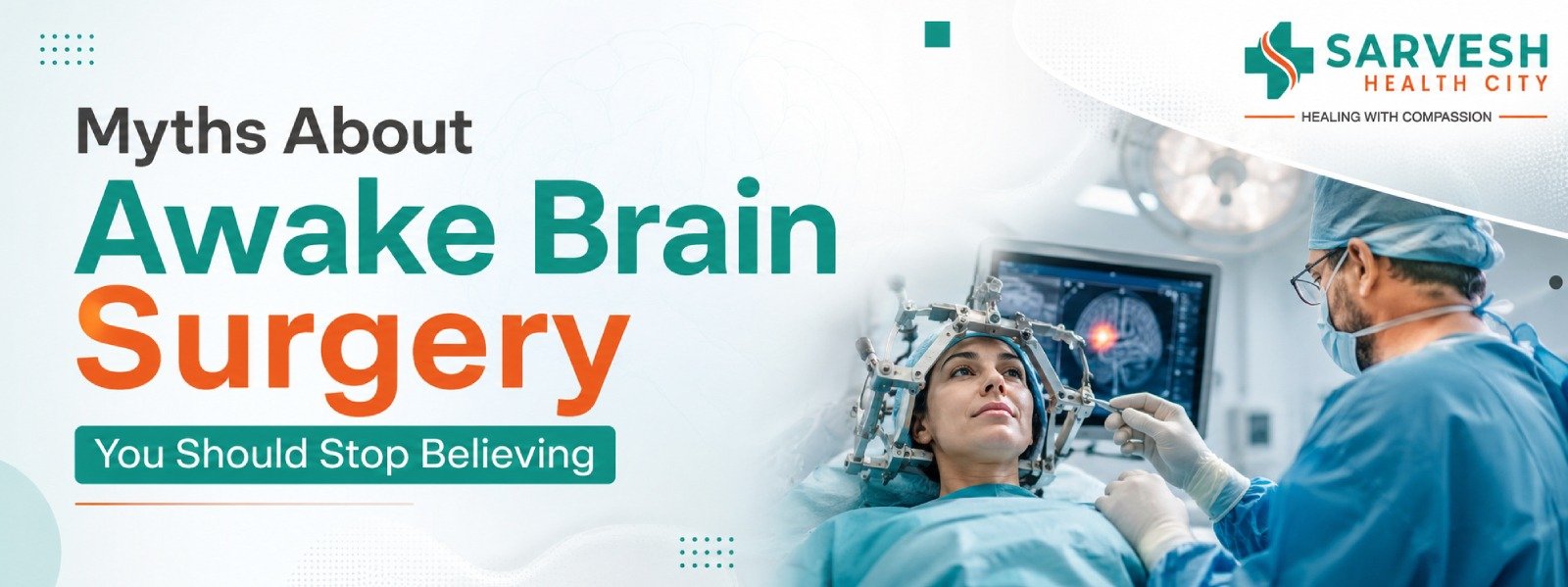
The surgical team, by asking the patient to be conscious during the operation, can carry out “intraoperative brain mapping“. They would be able to activate particular regions of the brain and request the patient to undertake simple tasks, such as naming a picture, counting, or moving a finger. If the patient is suddenly unable to speak or move, it is a signal to the surgeon that they have come upon a critical boundary and must quit. This immediate feedback helps a lot in ensuring that the vital functions are left intact, which could be jeopardized without it during deep general anesthesia.
Debunking the Most Common Myths
Since the idea goes against our natural instinct of being unconscious during surgery, multiple misunderstandings have sprung up. We will analyze the most frequent myths and the clinical facts that stand behind them.
Myth 1: “I will feel the surgeon cutting into my brain.”
The Reality: This fear in fact comes from misinterpretations of human anatomy. Actually the brain (neural tissue) is devoid of nociceptors (pain-sensing neurons). In reality, you cannot “feel” brain being touched, incisions, or even stimulation of it.
What really hurts, are the scalp, skin, and the periosteum (the membrane covering the skull). These parts are totally desensitized through a combination of potent local anesthetics and the induction of general anesthesia. It is only after the removal of the bone flap that the patient is reawakened and the surgeon prepares to handle the exposed brain tissue.
Myth 2: “I will be fully conscious and know about everything happening.”
The Reality: You won’t be fully awake and conscious during brain surgery. Actually, it’s more like a type of “sleep-wakefulness” state in clinical practice.
Patients are usually sedated to a light level. You are sufficiently conscious to communicate with the neurosurgeon’s prompts as well as to execute simple commands. However, you are not hyper-aware in that situation. The setting is under strict control; the surgical team handles the environment so that the patient is relaxed and attentive.
Myth 3: “Awake surgery is more risky than the one using general anesthesia.”
The Reality: From a long-term point of view, especially concerning brain health, awake surgery might even be safer than using general anesthesia. Of course, general anesthesia remains the standard for most operations. However, it completely shuts down the brain’s responses during surgery.
Imagine if a surgeon depends only on images while the patient is under anesthesia. In this case, the danger of removing a tiny part of very important and healthy brain tissue without realizing it is higher. This could cause serious and lasting brain problems like the person not being able to speak (aphasia) or being paralyzed. With an awake craniotomy, the surgeon can stop immediately if a brain function is impacted during the operation, which is a very effective way to prevent permanent disability.
Myth 4: “It is an outdated and ‘last option’ surgical technique.”
The Reality: In fact, awake craniotomy is a state-of-the-art method and the standard neuro-oncology and epilepsy surgery. It isn’t a “last resort” but is actually the first option for lesions in the frontal or temporal lobes.
The procedure makes use of very sophisticated equipment such as cortical stimulation pens and real-time brain activity monitoring. It is at the very forefront of personalized medicine where the surgery fits the specific functional map of each patient’s brain.
Myth 5: “I will be unable to move or communicate if something goes wrong.”
The Reality: Communication is the heart of the process. The medical team is continuously engaging with the patient. The patient is urged to state any discomfort or changes in feelings right away. The main purpose for the patient being awake during surgery is to keep the dialogue between the patient and the surgeon open so that the surgeon can react almost immediately.
Final Thoughts
Though the idea of being awake during brain surgery can be frightening for many people, it is actually a very effective technique that reduces the chance of complications while enhancing the possibility of a full recovery.
If you or someone you care about has been diagnosed with a complex neurological disorder, it is very important that you consult professionals that not only maintain global standards of care but also provide compassionate patient support. At Sarvesh Health City, we are extremely proud of ourselves as the best neurology hospital in Hisar, where the patients get the most advanced kinds of surgical treatments and a close-knit team to support them at every phase of their illness.