- Specialities
- Center of Excellence
- Specialitites
- ANAESTHESIA & INTENSIVIST
- BREAST SURGERY
- CRITICAL CARE
- DERMATOLOGY
- DIALYSIS
- DENTISTRY & MAXILLOFACIAL SURGERY
- ENT
- INTERNAL MEDICINE
- INTERVENTIONAL RADIOLOGY
- LAPAROSCOPIC & GENERAL SURGERY
- OBSTETRICS & GYNAECOLOGY & COSMETOLOGY
- OPHTHALMOLOGY (EYE CARE)
- PEDIATRIC CARE & NEONATOLOGY
- PHYSIOTHERAPY & REHABILITATION
- Services
- AMBULANCE SERVICES (24/7)
- BONE MARROW TRANSPLANT
- BLOOD CENTER (OPEN 24/7)
- EMERGENCY SERVICES (AVAILABLE 24/7)
- LAB AND PATHOLOGY (OPEN 24/7)
- NEONATAL INTENSIVE CARE UNIT (NICU) & PEDIATRIC INTENSIVE CARE UNIT (PICU)
- NUTRITION & DIETETICS
- PHYSIOTHERAPY & REHABILITATION SERVICES
- PREVENTIVE HEALTH CHECKUPS
- PHARMACY (OPEN 24/7)
- PET/CT SCAN
- RADIOLOGY & IMAGING SERVICES
- Blogs
- Health Library
- Our Empanelment
- About Sarvesh
- Specialities
- Center of Excellence
- Specialitites
- ANAESTHESIA & INTENSIVIST
- BREAST SURGERY
- CRITICAL CARE
- DERMATOLOGY
- DIALYSIS
- DENTISTRY & MAXILLOFACIAL SURGERY
- ENT
- INTERNAL MEDICINE
- INTERVENTIONAL RADIOLOGY
- LAPAROSCOPIC & GENERAL SURGERY
- OBSTETRICS & GYNAECOLOGY & COSMETOLOGY
- OPHTHALMOLOGY (EYE CARE)
- PEDIATRIC CARE & NEONATOLOGY
- PHYSIOTHERAPY & REHABILITATION
- Services
- AMBULANCE SERVICES (24/7)
- BONE MARROW TRANSPLANT
- BLOOD CENTER (OPEN 24/7)
- EMERGENCY SERVICES (AVAILABLE 24/7)
- LAB AND PATHOLOGY (OPEN 24/7)
- NEONATAL INTENSIVE CARE UNIT (NICU) & PEDIATRIC INTENSIVE CARE UNIT (PICU)
- NUTRITION & DIETETICS
- PHYSIOTHERAPY & REHABILITATION SERVICES
- PREVENTIVE HEALTH CHECKUPS
- PHARMACY (OPEN 24/7)
- PET/CT SCAN
- RADIOLOGY & IMAGING SERVICES
- Blogs
- Health Library
- Our Empanelment
- About Sarvesh
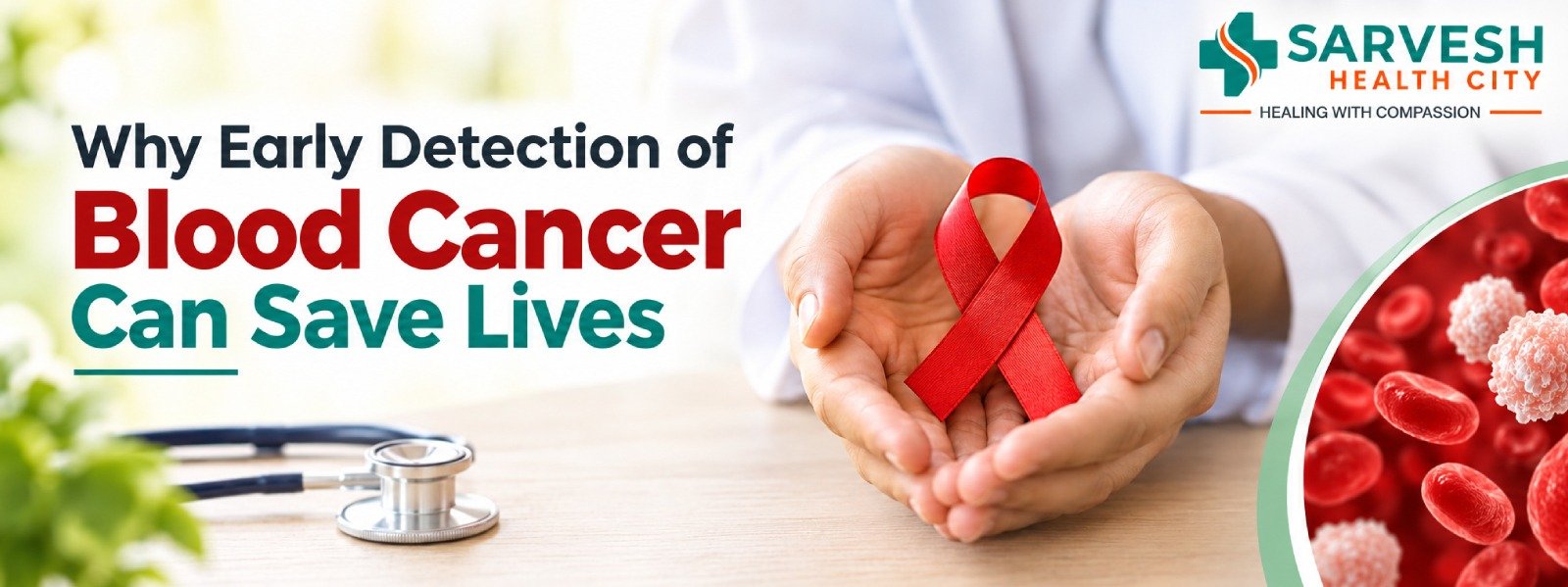
Blood cancer can develop in the blood, lymphatic system, or even bone marrow, and its early signs can be difficult to even notice. Conditions like leukemia, lymphoma, and multiple myeloma have symptoms that can be quite similar to those with infections, anaemia, or general tiredness.
Sometimes this is the reason people delay going to the doctor. Early detection of blood cancer can save lives and visiting a doctor on time can allow the physician to make an earlier diagnosis before the cancer spreads.
Sarvesh Health City, one of the best hematology oncology hospital in hisar, provides the access to specialized care by identifying symptoms in a timely manner.
What Is Blood Cancer?
Blood cancer is a group of disease that affect blood and its production in an uncontrolled manner due to changes and damage in DNA which also affects blood cell functioning. The major types of cancers are leukemia, lymphoma, and multiple myeloma, which have varying characteristics; different methods of diagnosis and require different treatments altogether.
Leukemia develops in the bone marrow where blood cell’s production happens. On the other hand, Lymphoma commonly emerges in lymphocytes, which are types of white blood cells, and usually includes the lymph nodes or other parts of the lymphatic tissue. Whereas multiple myeloma is when there is a defect or changes in plasma cells aka white blood cells.
Since these types of cancers can impact different parts of the body, their symptoms are widespread rather than being a particular problem in only one part of the body.
Early Signs That Should Not Be Ignored
Just having one or more of the following symptoms doesn’t immediately mean a person has blood cancer. It is very possible that these symptoms are the result of a viral infection, a nutritional deficiency, autoimmune conditions, or other medical issues. Nevertheless, it is advisable to see a doctor at the earliest if the symptoms are persistent and unexplainable.
Some warning signs might include:
- Feeling fatigued, tired, or weak all the time: This can be a result of low red blood cells and the symptoms are tiredness/being breathless or lightheaded.
- Recurrent or ongoing infections: Infections due to a lack or abnormality in the white blood cells which reduces the power to fight off infections.
- Unusual bleeding or bruising: When the platelets are low you may see that you bruise easily, nosebleeds, gum bleeding, or very small red spots on the skin.
- Fevers and/or night sweats: The fever in some blood cancer can be recurrent and also cause sweating in the night.
- Enlarged lymph nodes: For example, a swelling in the neck, the armpits, or the groins may be a clue to lymphoma.
- Weight is suddenly decreasing: If your weight has decreased without a change of diet or exercise then you must speak to your doctor.
- Back discomfort or muscular weakness: These are typical symptoms of many myeloma cases.
When these symptoms persists longer, get more severe, or occur together, a physician might help with comprehensive medical work-up.
How Is Blood Cancer Detected?
There is no universal blood test that can detect every type of blood cancer. That’s why, the diagnostic procedure depends on the particular symptoms and the probable cause.
However, the diagnosis begins with complete blood count (CBC). It counts red and white blood cells and platelets and can spot irregularities which require further examination. A peripheral blood smear test is the next in line, which is done with a microscope.
If necessary doctors will do bone marrow aspiration and biopsy, and there are also other tests like flow cytometry, chromosome and molecular or genetic testing to pinpoint exactly the type of the blood cancer and determine the best way of treatment.
For a more accurate diagnosis of lymphoma it will also require taking images and examining lymph nodes. In multiple myeloma, diagnostic information needs blood and urine reports, bone marrow, and imaging tests.
Why Early Evaluation Matters
Early diagnosis does not mean that all blood cancers can be detected through regular screening. In fact, there are hardly any widely recommended screening tests for blood cancers in individuals without symptoms.
Detection during early stages of the disease may help doctors to better understand the situation and, depending on the type of cancer, offer more treatment choices. Diagnosis also helps identify the type and various biological characteristics of the disease, playing a major role in developing an appropriate treatment plan.
Delaying the diagnosis and treatment may lead to the progression of the underlying complications such as severe anemia, bleeding, kidney failure, infections, other organs failure, etc.
Where Comprehensive Hematology-Oncology Care Can Help
Typically, blood cancer care requires involvement of more than one medical speciality, such as hematologists, medical oncologists, pathologists, transplant specialists, radiologists, and supportive-care professionals working together according to the diagnosis.
At Sarvesh Health City, we have some of the best services for blood cancer patients in the haematology-oncology department, whether it is molecular diagnosis, chemotherapy, targeted therapy, immunotherapy, or bone marrow/stem cell transplantation.
Other departments like radiotherapy, surgical oncology, and pathology are also inside the hospital for treating cancer patients.
Final Thoughts
Blood cancer does not always announce itself with an obvious symptom. Fatigue, repeated infections, unexplained bruising, persistent fever, swollen lymph nodes, or unexplained weight loss can have many causes, but persistent changes should not simply be ignored.
Early detection of blood cancer at the best hematology oncology hospital in Hisar can save lives by helping patients reach the right diagnostic pathway sooner and allowing doctors to understand the disease before complications become more difficult to manage. If you see any of the above-mentioned early signs of blood cancer, connect with a qualified doctor at Sarvesh Health City for the correct diagnosis.
Frequently Asked Questions
Q1. How can one identify blood cancer at the earliest?
Ans. The early signs of blood cancer include persistent fatigue, unexplained fever, frequent infections, bruising or bleeding, swollen lymph nodes, sudden weight loss, and sometimes bone pain.
Q2. Is CBC test enough to detect blood cancer?
Ans.No, but it is the first test that can help identify abnormalities in blood-cell counts. And this can be lead to further investigation, including blood smear, bone marrow examination, flow cytometry, and molecular testing.
Q3. Are there routine screening tests for blood cancer?
Ans. There are no routine screening test but some blood cancers may be discovered when tests are performed for another reason, while others are investigated after symptoms appear.
Q4. Are leukemia, lymphoma, and multiple myeloma, all the same type?
Ans. No, these are different types of blood cancers: leukemia occurs due to abnormal blood-forming cells, lymphoma occurs due to lymphocytes, while multiple myeloma is one developing in white blood cells.
Q5. Does unexplained fatigue or bruising means blood cancer and I should visit the hospital instantly?
Ans. Yes, these are the signs that could mean blood cancer and if not, at least visiting the hospital can help you rule out the actual cause.
Media Enquiries
- Sarvesh Health City
- Sarvesh Health City Site No. 1, Sector 14, Hisar – 125001 (Haryana)
- +91 6901 626262
- +91 6901 636363
Social Media
Healthcare at your fingertips



HOD & SR.CONSULTANT SURGICAL ONCOLOGY AND ROBOTIC SURGERY