- Specialities
- Center of Excellence
- Specialitites
- ANAESTHESIA & INTENSIVIST
- BREAST SURGERY
- CRITICAL CARE
- DERMATOLOGY
- DIALYSIS
- DENTISTRY & MAXILLOFACIAL SURGERY
- ENT
- INTERNAL MEDICINE
- INTERVENTIONAL RADIOLOGY
- LAPAROSCOPIC & GENERAL SURGERY
- OBSTETRICS & GYNAECOLOGY & COSMETOLOGY
- OPHTHALMOLOGY (EYE CARE)
- PEDIATRIC CARE & NEONATOLOGY
- PHYSIOTHERAPY & REHABILITATION
- Services
- AMBULANCE SERVICES (24/7)
- BONE MARROW TRANSPLANT
- BLOOD CENTER (OPEN 24/7)
- EMERGENCY SERVICES (AVAILABLE 24/7)
- LAB AND PATHOLOGY (OPEN 24/7)
- NEONATAL INTENSIVE CARE UNIT (NICU) & PEDIATRIC INTENSIVE CARE UNIT (PICU)
- NUTRITION & DIETETICS
- PHYSIOTHERAPY & REHABILITATION SERVICES
- PREVENTIVE HEALTH CHECKUPS
- PHARMACY (OPEN 24/7)
- PET/CT SCAN
- RADIOLOGY & IMAGING SERVICES
- Blogs
- Health Library
- Our Empanelment
- About Sarvesh
- Specialities
- Center of Excellence
- Specialitites
- ANAESTHESIA & INTENSIVIST
- BREAST SURGERY
- CRITICAL CARE
- DERMATOLOGY
- DIALYSIS
- DENTISTRY & MAXILLOFACIAL SURGERY
- ENT
- INTERNAL MEDICINE
- INTERVENTIONAL RADIOLOGY
- LAPAROSCOPIC & GENERAL SURGERY
- OBSTETRICS & GYNAECOLOGY & COSMETOLOGY
- OPHTHALMOLOGY (EYE CARE)
- PEDIATRIC CARE & NEONATOLOGY
- PHYSIOTHERAPY & REHABILITATION
- Services
- AMBULANCE SERVICES (24/7)
- BONE MARROW TRANSPLANT
- BLOOD CENTER (OPEN 24/7)
- EMERGENCY SERVICES (AVAILABLE 24/7)
- LAB AND PATHOLOGY (OPEN 24/7)
- NEONATAL INTENSIVE CARE UNIT (NICU) & PEDIATRIC INTENSIVE CARE UNIT (PICU)
- NUTRITION & DIETETICS
- PHYSIOTHERAPY & REHABILITATION SERVICES
- PREVENTIVE HEALTH CHECKUPS
- PHARMACY (OPEN 24/7)
- PET/CT SCAN
- RADIOLOGY & IMAGING SERVICES
- Blogs
- Health Library
- Our Empanelment
- About Sarvesh
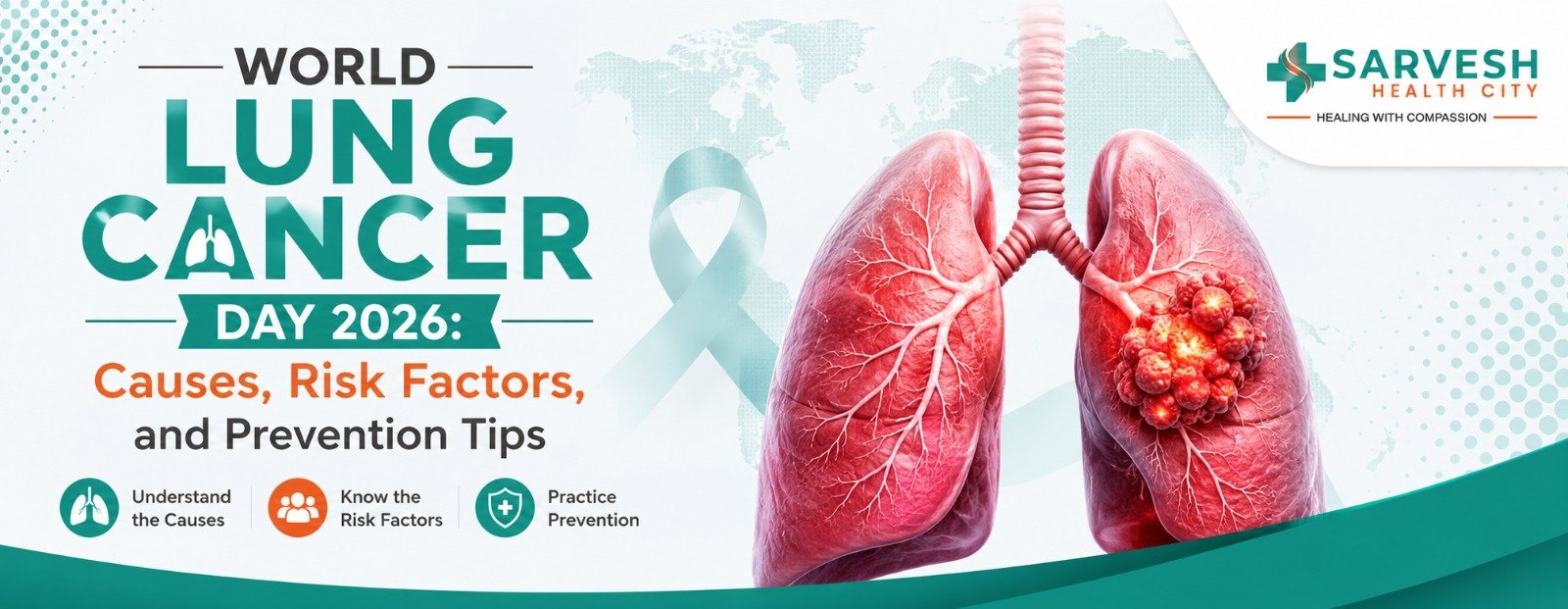
World Lung Cancer Day is observed every year on August 1 to create awareness about one of the deadliest cancers in the world. The campaign focuses on early detection, prevention, education and support for people living with lung cancer. It also highlights the need to reduce tobacco use, improve air quality, and increase access to timely diagnosis and treatment.
Despite medical advances, lung cancer remains the leading cause of cancer-related death worldwide. Improved screening programs, precision medicine, immunotherapy, and greater public awareness have all helped survival rates to continue to rise.
This blog covers the causes, risk factors, symptoms, diagnosis, treatment, prevention strategies, and the importance of World Lung Cancer Day 2026.
History and Importance of World Lung Cancer Day
World Lung Cancer Day was created to raise awareness about one of the deadliest cancers in the world and to help combat the stigma of the disease. This is not wholly correct as shown by medical research today. Lung cancer can also develop in non-smokers, due to environmental pollution, exposure to harmful chemicals at work, second-hand smoke, radon gas and inherited genetic mutations. The awareness campaign has moved from merely talking about smoking cessation to advocating for holistic lung health, screening and equitable access to modern cancer care.
With healthcare organizations focusing on prevention and personalized treatment, the importance of World Lung Cancer Day has become more significant. With growing public awareness, people live more healthily, quit smoking, cut down exposure to pollutants and seek medical advice promptly when symptoms arise. Bottom line: this awareness saves lives and early intervention is important.
Why Lung Cancer Remains a Global Health Challenge
Lung cancer remains one of the most serious public health problems, as it is often diagnosed late, when treatment options are more complicated. The disease progresses silently in many people, with symptoms such as persistent cough, chest pain, breathlessness appearing only after the cancer has progressed. At the same time, the process of urbanization is progressing, air pollution is increasing, people are aging, and smoking continues to create new patients worldwide. Healthcare systems are therefore focusing on better treatment but also prevention, education and screening initiatives.
Immunotherapy has revolutionized treatment for many advanced lung cancers by allowing the body’s immune system to better recognize and attack cancer cells. Such advances show that while lung cancer is still a formidable foe, ongoing research, public awareness and early diagnosis are slowly changing the outlook for many patients.
What Is Lung Cancer?
These cancer cells can develop into tumors that disrupt the normal function of the lungs and may spread to other parts of the body over time.
The lungs provide oxygen to the blood. If the cancer is in the lung tissue, it can be hard to breathe. If the cancer is not caught early, your health can deteriorate .
Lung cancer is mainly classified into two types:
1. Non–small cell lung cancer (NSCLC)
This is the most common type, accounting for about 85% of all lung cancers.
Typical subtypes are:
- Adenocarcinoma
- Squamous cell cancer
- Large-cell carcinoma
In general, NSCLC tends to grow more slowly than small cell lung cancer.
2. Small-cell lung carcinoma (SCLC)
Small cell lung cancer is not frequently seen but very aggressive. It is mostly aggressive and spreads very quickly to other parts of the body.
It is strongly related to long-term cigarette smoking.
What Causes Lung Cancer?
Smoker
The chief culprit is smoking. The harmful chemicals will cause harm to lung cells in a gradual manner, causing cancer.
Second-hand Smoke
Living or working with smokers also increases your risk.
Air Pollution
Polluted air can damage lung tissue if we are exposed to it for long periods of time.
Work Exposure
People working around:
- Asbestos
- Exhaust from diesel
- Silica dust
- Heavy metals
There may be increased risk for industrial chemicals.
Radon Gas
Radon is a gas produced naturally and is radioactive in nature.
History of Family
Having a family history of lung cancer may put you at greater risk.
Past Lung Diseases
Other chronic respiratory diseases, including COPD, pulmonary fibrosis, or even recurring lung infections can predispose someone to lung cancer, though they themselves do not cause cancer.
Risk Factors You Should Never Ignore
You may have a higher risk if you:
- Smoke cigarettes
- Used tobacco for many years
- Are exposed to passive smoking
- Work in hazardous industries
- Have COPD
- Have chronic lung diseases
- Have a family history of lung cancer
- Are exposed to indoor or outdoor air pollution
Early Warning Signs of Lung Cancer
As the disease advances, symptoms may include:
- Chronic cough for more than three weeks
- Blood coming up while coughing
- Pain in chest
- Shortness of breath (SOB)
- Harsh tone
- Recurrent chest infections.
- Tired out
- Lose weight effortlessly
- Decreased appetite
- Wheezing
Persistent respiratory symptoms should be evaluated by a health care professional without delay.
How Lung Cancer is Diagnosed
A chest x-ray is generally performed initially, but it may not show the tumors at times. A CT (computed tomography) scan produces detailed pictures and is often done for detecting any abnormalities in the lungs. For those who are considered to be at high risk, a low-dose CT (LDCT) screening is recommended, which helps to detect lung cancer even before symptoms begin showing up. With the Best Pulmonology Treatment Hospital In Hisar, the use of the latest imaging equipment coupled with professional pulmonologists will guarantee a correct diagnosis.
In case any abnormality is found during imaging, the following additional tests may be performed:
- PET-CT Scan to know whether cancer has metastasized.
- Bronchoscopy to look inside the airways and collect tissue sample.
- Biopsy by needle under CT guidance.
- EBUS Biopsy to sample lymph nodes near the lungs.
- Blood Tests to evaluate general well-being before starting treatment.
Biopsy is still the definitive procedure to confirm lung cancer. After the confirmation of the diagnosis, doctors assess the stage of the disease, from Stage I (Localized), to Stage IV (Advanced Metastatic Disease).
Prevention Tips That Can Save Lives
Although not every case can be prevented, several lifestyle choices significantly reduce risk.
Stop Smoking
Quitting smoking at any age reduces the chance of lung cancer and benefits your general health.
No Second Hand Smoke
Prevent smoking inside houses, work environments and public areas.
Exercise Regularly
Exercise helps keep your lungs healthy and increases your immunity. Try to get at least 150 minutes of moderate activity a week.
Eat a Healthy Diet
- Fruit
- Vegetables
- Whole-grains
- Proteins, lean
- Healthy fats
Antioxidants in a balanced diet help maintain cellular health.
Reduce Air Pollution Exposure
- Exercise outside only when pollution levels are low.
- Use indoor air purifiers if needed.
- Follow workplace safety guidelines.
The Role of World Lung Cancer Day 2026
Lung cancer is a serious problem that requires more attention and care. The World Lung Cancer Day 2026 focuses on how people need to raise their awareness about this problem and take some steps to get a proper diagnosis in time.
There are special events organized by hospitals and other medical institutions related to this day. You might proceed with your check-up if you have detected some problem or you just wish to be on the safe side.
How We Can Support World Lung Cancer Day 2026
Anyone can help lessen the burden of lung cancer by:
- Learning about lung cancer risks
- Helping Your Loved One Quit Smoking
- Take part in awareness campaigns
- Helping patients & caregivers
- Encouraging regular health screenings
- Giving accurate health information
Awareness opens up opportunities for prevention, early diagnosis and better results.
Conclusion
Lung cancer is considered one of the biggest threats for health around the world, but the future for patients looks brighter because of improvements in the area of early diagnostics, targeted medicines, precision oncology, immunotherapy, and minimally invasive surgeries.
Celebrating World Lung Cancer Day in 2026 means that we can raise awareness and prevent this problem through early diagnosis and treatment. Stopping smoking, avoiding the secondhand smoke, minimizing the risk of getting the harmful substances, living a healthy life, and undergoing regular lung cancer screenings are very useful preventive actions that everyone should follow. The pulmonologists from Sarvesh Health City are experienced specialists who are willing to diagnose and treat lung cancer on time.
Frequently Asked Questions (FAQs)
Q1. When is World Lung Cancer Day celebrated?
Ans. World Lung Cancer Day is observed on 1 August every year to raise awareness about lung cancer and to support early diagnosis, prevention and treatment of lung cancer patients around the world.
Q2. What is the main reason for lung cancer?
Ans. Smoking is the cause of lung cancer. But lung cancer can also develop in non-smokers, due to passive smoking, air pollution, radon gas, exposure to toxic substances at work.
Q3. Is it possible to prevent lung cancer?
Ans. Not every case of lung cancer can be prevented, but many can be avoided by not smoking, avoiding second-hand smoke and air pollution, maintaining a healthy lifestyle, and getting screened if you are at high risk.
Q4. What are the earliest signs and symptoms of lung cancer?
Ans. Initial symptoms of lung cancer are coughing, even if blood is coughed up, problems with breathing, shortness of breath, weightloss, weakness, harsh voice, and lung inflammation.
Q5. What are the latest treatment options for lung cancer in 2026?
Ans. Among the treatment choices for the disease are treatments like a surgery, radiation, different kinds of chemotherapy, new kinds of treatments like targeted therapy, and immunotherapy.
Media Enquiries
- Sarvesh Health City
- Sarvesh Health City Site No. 1, Sector 14, Hisar – 125001 (Haryana)
- +91 6901 626262
- +91 6901 636363
Social Media
Healthcare at your fingertips



PULMONOLOGIST
Discover why Dr. Nidhi Mahajan at Sarvesh Health City is regarded as Hisar’s leading pulmonologist, offering expert care, advanced treatments, and trusted results.